



Wi-Fi (W-LAN) refers to a local wireless network based on the IEEE 802.11 standards. It enables access to the Internet—for example, from devices such as PCs, laptops, tablets, and smartphones—as well as to geographically limited networks.
Use of WLAN in Intralogistics
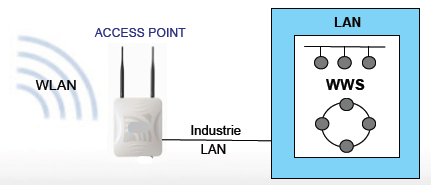
When used in intralogistics, Wi-Fi is typically operated in what is known as infrastructure mode, which is comparable in principle to a cellular network. Via Wi-Fi routers or so-called access points, mobile devices (clients) can be easily and wirelessly connected via Wi-Fi to the connected merchandise management system (MMS). The WMS is usually connected to the access points via an “Industrial Local Area Network”. To facilitate the connection, access points transmit signals containing connection information at defined intervals. The clients detect the available network, process the received information, and the two devices connect to each other. To ensure security, industrial networks typically require access secured by a password and encryption. And depending on the type of warehouse, the picking method, and the internal business processes, a wide variety of mobile devices—such as MDE, smartphones, tablets, and PCs—are in use; via access points distributed throughout the warehouse, they can now communicate with the WWS.
Data Throughput / Speeds of Wi-Fi
Unlike UMTS, HSDPA, or LTE—which provide wireless coverage specifically for mobile communications—Wi-Fi is a short-range technology. When it comes to speed, however, Wi-Fi generally offers higher data rates. The so-called IEEE 802.11 standards, which specify frequencies and the aforementioned transmission standards, are now available in various versions. What began with the 802.11 standard back in 1997 has, over the years, achieved a certain degree of continuity in the IT industry through the 802.11a, 802.11b, and 802.11g standards. Currently, most devices (both transmitters and receivers) support the 802.11n standard, which was ratified in 2009. The 802.11ac standard, introduced in 2013, is an improved extension of the 802.11n standard. In addition, both N and AC are not only capable of operating at the 2.4-gigahertz frequency but also support the higher-performance 5-gigahertz band. Theoretically, speeds of up to 600 megabits per second are possible with the N standard, while the AC standard is expected to transmit at 6.77 gigabits per second in the future. The AD standard, which has not yet been ratified, is expected to be added in the future.
For more information on the use of wireless technology, see Bluetooth – Data Transmission via Wireless Technology.
Image source: © Ji SIGN – Fotolia.com
