


Bluetooth is primarily used as a replacement for wired connections between two electronic devices. It provides the interface through which small mobile devices such as cell phones, smartphones, tablet PCs, and PDAs, as well as computers and peripheral devices, can communicate with one another.
Bluetooth-enabled devices are based on the standards of the “Bluetooth Special Interest Group” (SIG). They are also referred to as “Short Range Devices” (SRD). These devices may be operated worldwide without a license. They transmit on a license-free frequency band between 2.402 GHz and 2.480 GHz, the ISM band (Industrial, Scientific, and Medical band).
Frequency hopping significantly reduces the susceptibility of the radio signal to interference. In this process, the frequency band is divided into 79 different frequency steps spaced 1 MHz apart and then switched up to 1,600 times per second.
Examples of general Bluetooth applications:
- Connecting audio devices (headphones, microphones, headsets, etc.) to computers or mobile devices.
- Connecting input devices (“Human Interface Devices (HID)” such as mice, keyboards, etc.) to computers.
Examples of Bluetooth applications in intralogistics:
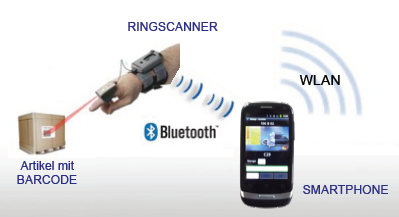
- Smart Mobile Logistics: A ring scanner scans a barcode and communicates with the smartphone via Bluetooth. The smartphone establishes a wireless connection to the wireless access point via a wireless adapter. This allows a standard smartphone to be used just like an industrial MDE .
For more information on connecting IT systems, see Interfaces.
Image source: © Vector_Master – Fotolia.com
