


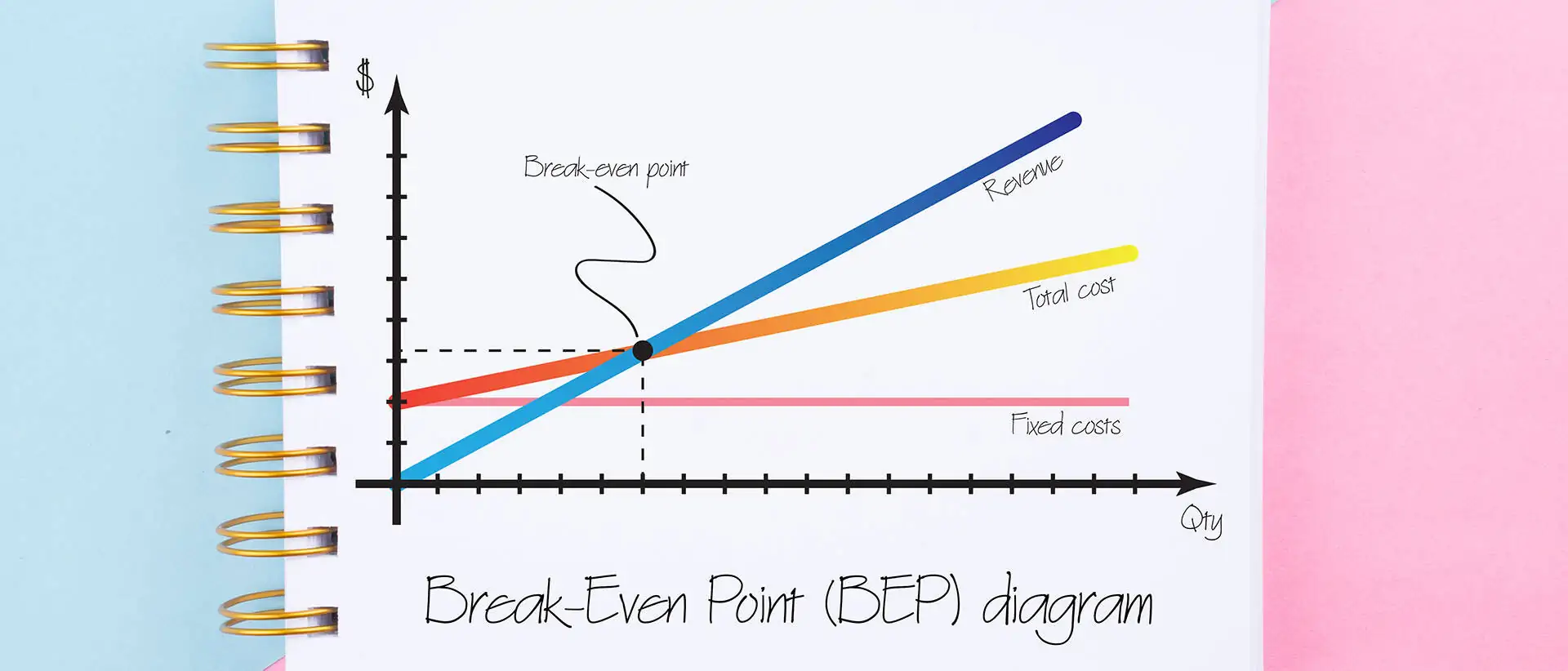
A break-even analysis provides insight into the sales volume at which revenue equals costs. Companies can use it to calculate the break-even point (BEP), also known as the profit threshold. The break-even point is the zero point of the profit function.
Break-Even Analysis: Calculating the BEP to Determine In-House or Outsourced Warehousing
To determine the sales volume at which warehousing should be handled in-house or outsourced, the rule of thumb is: Costs of in-house warehousing = Costs of external warehousing
Example:
Costs of in-house storage: Fixed costs 12,000 euros + variable costs 10 euros per unit
Costs of third-party storage: Variable costs 40 euros per unit
The equation is solved for x to determine the quantity (x) at which the costs of in-house and third-party storage are equal.
12,000 + 10x = 40x
12,000 = 30x
x = 400
According to this calculation, the costs of in-house and outsourced warehousing break even at a quantity of 400 units. Taking other factors into account, in-house warehousing should be considered starting at this quantity.
For more information on in-house storage, see In-House Storage.
Image source: © Thingamajiggs – Fotolia.com
