


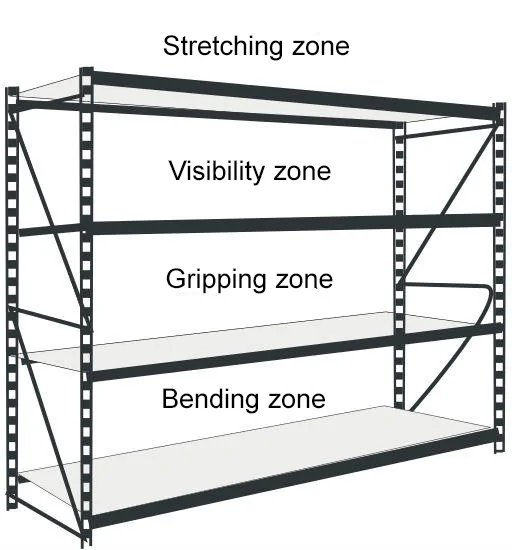
A warehouse shelf, whether used in intralogistics or retail, can be divided into various horizontal shelf zones. This typically results in four shelf zones, which are named from bottom to top as follows:
- Bending Zone
- Reaching Zone
- Viewing Zone
- Stretching Zone
The height of the shelving zones essentially corresponds to their respective names. The division is based on an adult’s height. Accordingly, items in the bending zone are located at the lowest level; items in the reaching zone are at a relatively comfortable reaching height; goods in the viewing zone are at eye level; and to retrieve items from the stretching zone, one must reach up to the top level.
Advantages of Shelving Zones
Advantages resulting from this division include, for example, a more organized arrangement of goods on the shelf, improved workplace ergonomics (for instance: older employees are only tasked with picking of goods in the reach and sight zones) or a faster throughput time thanks to the structured arrangement and the reduced time required for picking. Likewise, the different placements allow for the use of sales-promoting psychological effects at the point of sale, which in turn are specifically leveraged by manufacturers, brands, and store operators. The placements in the respective shelf zones are also subject to varying “placement prices,” particularly in the food retail sector, with the visibility zone representing the most sought-after area.
The individual shelf zones are described in more detail below:
Shelf Zones – Bending Zone
Based on the height of an average adult (1.70 m), a shelf can be divided into vertical zones. The lowest shelf area is called the bending zone. It extends, on average, to a height of 60–80 cm.
Goods with low turnover are often stored in the bending zone. However, expected sales volume is not the sole determining factor for product placement. The storage zone near the floor is also suitable for heavy and bulky goods. In supermarkets, on the other hand, the bending zone typically contains low-priced products or the respective retail chain’s low-cost private-label brands.
The bending zone from an ergonomic perspective
For ergonomic reasons, high-turnover merchandise should not be stored in the bending zone, as the order picker must exert additional physical effort—for example, by frequently kneeling to reach the merchandise in question. This extra effort is not only strenuous for the person but also adds time to the picking process.
Shelf Zones – Reaching Zone
Based on the height of an average adult (1.70 m), a shelf can be divided into vertical zones. The reach zone typically begins at a height of 60–80 cm and extends up to a height of 1.40–1.60 m.
Employees can reach the reach zone without additional aids. Therefore, goods that are considered high-turnover items are typically stored in this area. Thus, during order picking , time is saved through quick retrieval, and employees expend little energy due to the ease of retrieval.
Shelf Zones – Eye Level Zone
Based on the height of an average adult (1.70 m), a shelf can be divided into vertical zones. The eye level zone typically begins at a height of 1.40–1.60 m and extends, depending on the situation, up to a height of 1.80 m.
The visibility zone is the storage area located at the picker’s eye level. Goods stored in this area are considered to have the highest turnover.
As with the reach zone, the ease of retrieval saves time and energy. A key advantage is that putaway and retrieval are the fastest, since the order picker can get an overview of the storage area in the shortest amount of time. In retail, this also applies to the customer’s perspective: merchandise in the visibility zone receives the most attention from customers. This shelf zone is therefore the area where manufacturers prefer to position their brand-name products.
Shelf Zones – Top Shelf Zone
A shelf is divided into vertical zones based on the height of an average adult (1.70 m). The top shelf zone is the uppermost storage area and begins, on average, at a height of 1.80 m.
Storing or retrieving merchandise in the top shelf zone requires the most effort. For this reason, this area is often used to store merchandise with the lowest turnover rates. When putting goods into or removing them from storage, the order picker uses order picking various tools, such as a ladder, forklifts or rack-feeding machines. Using these tools is time-consuming and therefore has a negative impact on the picking time.
Conclusion
The division of a shelf into different shelf zones is practiced both in intralogistics within warehouses and in retail sales. The placement of merchandise in the respective zones depends on its turnover rate, weight, size, and ergonomic factors that affect the work and effort of order pickers. In retail, on the other hand, the focus of merchandise placement is more on the customer’s perspective. The goal is to positively influence customers and encourage them to make a purchase by placing products in appropriate shelf zones.
You can find additional articles on this topic at Movement Strategies in Warehouse Operations, particularly regarding the single-player strategy. In addition, the following articles are relevant in the context of retail:
Electronic shelf label / Shelf Label
Point of Sale and Brick-and-Mortar Retail – Definition
Image source: Teaser: © Tiero – Fotolia.com; Image in article – © Rfc1394 License: (CC BY-SA 3.0)
