

“Goliath 61” is a major retrofit project by Hermes Fulfilment GmbH that involves comprehensive technology and software modernization. In this interview, we speak with Corinna Falk, Head of Logistics Consulting and Planning for In-House Projects, and Barbara Schröder, Senior Project Manager, at Hermes Fulfilment.
This interview is part of a series in which we speak with those involved about the joint Goliath 61 project in Haldensleben.
Please briefly introduce yourself and your role within the company.
Barbara Schröder: I am Barbara Schröder, Senior Project Manager, and I have been with the company for over fifteen years. I’m responsible for intralogistics projects with a focus on processes, construction, engineering, and IT. These range from smaller projects involving purely software changes to a project like Goliath 61, which is in the mid-double-digit millions range. A key aspect of my work is bringing together the right experts across all organizational levels—from procurement to IT, operations technicians, and those responsible for day-to-day operations—to manage each project in a way that ensures its success.
Corinna Falk: I am Corinna Falk, Head of Logistics Consulting and Planning for in-house projects at Hermes Fulfilmet, and I have been with the Otto Group for over 20 years. There, I have gained experience in various logistics-related areas, both as a project manager and as a department head. In my current role, in addition to coaching our project managers, I take on subject-specific responsibility for their projects—which range from large-scale projects, such as Goliath 61, to complex digitization initiatives, and even work studies. In the latter, we take a very close look at workstations to optimize processes there with a specialized team.
When and how did you become involved in the project?
Corinna: In early 2021, we were asked to address the issue of wear and tear in the high-bay warehouse at our distribution center in Haldensleben near Magdeburg. Downtime and maintenance intervals there were steadily increasing. The assignment was therefore to explore possible solutions to this problem. We considered various options, ranging from replicating the existing stacker cranes to completely new technical solutions and approaches. We also questioned whether the high-bay warehouse should continue to serve as a replenishment and reserve warehouse for order picking, or whether we needed to rethink the concept entirely.
However, a study conducted in 2022 showed that the high-bay warehouse is the best and most cost-effective solution for our retail partners, including in terms of service level agreements. Following that, we took a very close look at the options available to meet our requirements in order to find cutting-edge technologies for our warehouse. We then used this information to proceed with the request for proposals.
Barbara: I joined the team in early 2022, shortly after the assignment was given to Corinna. At that time, initial discussions were already underway with providers of high-bay warehouse and stacker crane solutions to determine how they would approach our project requirements. Since I had already overseen the installation of six new stacker cranes in 2011—which involved many changes to the control system—my detailed knowledge made me the ideal person for the Goliath 61 project. As Corinna already explained, we first evaluated various solution approaches both internally and on the market, concluding that we should opt for a high-bay warehouse with aisle-specific stacker cranes, meaning that all 61 aisles, with a total of 1.2 million storage locations, would each have their own stacker crane. We submitted this proposal in the RFP. Interest was very high, and we received responses from many vendors. The result was a partnership with Stöcklin, which in turn collaborated with TUP on the implementation of the material flow computer.
What were Hermes Fulfilment’s expectations for the collaboration in this setup? Were there any key areas that were given particular emphasis?
Barbara: I’ve known TUP for almost as long as I’ve been with the company—about fifteen years. I’ve found TUP’s employees to be technically knowledgeable project partners who work professionally and as equals. This technical expertise was invaluable to me, as was their knowledge of the site, which TUP has been supporting since 1990—that is, since it went into operation.
Corinna: I can certainly confirm that. To come back to the question about expectations: They were very high, in part because TUP, as a long-standing service provider, was responsible for our current control system in the technical computer and thus also served as the on-site interface for Stöcklin and the TUP MFR. So we were working with TUP on both sides of the project, and naturally, that leads to high expectations of the supplier—but also the confidence that those expectations will be met.
What is the current status of the project?
Barbara: The pilot stacker crane was installed at the end of 2025 and accepted in all essential respects. The installation site for the next four units was opened this week (Calendar Week 18, 2026). Installation will begin at the end of May, at which time two old stacker cranes will be removed from the warehouse. This ongoing process of replacing old equipment with new will now continue step by step.
We’re proceeding in eight construction phases, and the current batch of four is actually the smallest. After that, we’ll be handling between seven and ten units per delivery. By the end of 2028, we’ll have deployed all 61 new units and all 39 old ones, along with their eight transfer units. It’s important to remember that the old equipment also has to be moved out through the bottleneck of the four roof openings.
As far as the material flow computer is concerned, the biggest switch already took place in March 2025: We replaced the old MFC and its applications with the new one. That was a huge milestone for us and TUP, because the material flow computer knows where each carton is located and which RBGs have tasks to perform. That makes it the heart of the warehouse. In early 2026, there was another milestone when the TUP.MFC took over control of the pilot stacker crane and, from an IT perspective, control of all new stacker cranes while simultaneously managing the older units. As a result, we now only have to perform “mini-commissionings,” during which we “introduce” the newly installed stacker crane to the MFC. TUP’s main part of the project is now complete.
Corinna: Regarding our collaboration, it’s worth noting that TUP, together with Stöcklin, presented a solid concept as early as the proposal phase. This concept called for first replicating the old MFR with new technology to control the legacy devices, before then making the necessary adjustments to control the new devices. This already demonstrated to us during that phase that this would provide the best—and, above all, the lowest-risk—migration concept. That is, if one can even speak of “low risk” when, to put it bluntly, you’re “replugging” the heart of a logistics center. This is especially true given that the documentation for the old material flow computer wasn’t always entirely complete.
Barbara: Yes, we called the concept “MFC First”, which means replacing the material flow computer first and then integrating the devices. There was also an intensive discussion beforehand about the extent to which it made sense to build an MFC with special logic for the old devices—which operate differently in many areas (especially with the transfer logic and the large load-handling device) than the new stacker cranes —only to then no longer use those functions. In retrospect, “MFC First” was exactly the right approach.
What were the benefits that resulted from this decision?
Barbara: We also explored other concepts, such as parallel operation.
The new material flow computer would have gradually taken on more tasks, and the old one would have been “phased out.” That would have had the major advantage of allowing us to avoid the issue of writing code only to no longer use it at some point, but the major disadvantage would have been that the inventory management system would have had to be coordinated across two different material flow computers—and, on top of that, by the overarching technical computer. That would have raised many complex questions: Is the carton in the old MFC’s area or already in the new one’s? What priorities do I assign during picking? We would have had to reevaluate all of this repeatedly in an environment that would be constantly changing over the course of three years. This would have quickly led to complex requirements that would have affected multiple systems as well. These were strong arguments for implementing the “MFC-First” concept after all.
Corinna: This is how we ensured stability over these three years, and now we don’t have to worry about balancing between two MFCs when new devices come in.
How did the collaboration go on a professional and personal level?
Corinna: From my perspective, we have a very good project atmosphere: collaborative, on equal footing, and very goal-oriented.
Barbara: I can certainly agree with that. From the start of the project until the new MFC went live, the collaboration took place mainly between TUP and us; it wasn’t until the pilot RBG that it became a three-way partnership between our Swiss partner Stöcklin, TUP, and Hermes Fulfilment.
How did communication go during the project?
Barbara: In my view, it went very well. Especially when discussing the material flow and technical computers, we had TUP project manager Rolf Hörmann by our side—someone with very deep technical expertise in the subject matter, which really accelerated the project. TUP implementation manager Yannick Schellert also deserves special mention in this regard. At the start, we were still missing the C developers for the technical computer, so we had to do a bit of juggling there. But by the time of the “Big Bang” in March 2025, we had found a solid path forward.
Corinna: Every now and then, bottlenecks arise when knowledge is concentrated in only a few people’s heads. That’s why we’re pleased that these risks are being managed on the TUP side—both now and in the future—and that steps are being taken to ensure we aren’t dependent on individual people.
What advantages do you see in the solutions implemented from a software and hardware perspective?
Barbara: Thanks to Stöcklin, we’ve gotten new technology in a familiar package, which we’re incredibly happy about. This allows us to continue using the building envelope, the entire racking system, and the supply and disposal conveyor systems, all of which are highly integrated into the site’s overall material flow. This is both sustainable and economical. With Stöcklin, we’ve not only found a company that can serve our particularly narrow aisles but has also implemented our special request for an emergency control station for the operations technicians. It has also enabled us to significantly reduce the complexity of our processes. Since each aisle now has its own stacker crane, the transfer units are no longer needed, freeing up space. The new units are also much lighter, faster, and more streamlined in design.
Corinna: The new units offer the advantage that we can use standard components from Stöcklin, which can be replaced quickly and are also much easier to maintain. Nevertheless, they are customized to our specific needs, especially with regard to the warehouse’s height of 27 meters, which is not standard for automated small-part storage and retrieval (AS/RS) technology. Overall, our collaboration with Stöcklin was conducted on an equal footing, and we always felt well advised and supported in addressing our challenges. From the very beginning, Stöcklin worked on the solution with excellent preparation and immediately understood what we needed.
What was the situation on the software side?
Barbara: Let’s start by looking at the material flow computer: Thanks to its web-based interfaces, it now offers a completely different “user experience” compared to the old MFC, which could only be controlled via keyboard input. A large portion of the dialogs was customized for us, which allows us to map certain processes exactly as we need them for our operations. 61 aisles is simply an enormous number. I don’t know of any high-bay warehouse that has more. With the new user interface, we can now manage these dimensions much more effectively and respond more quickly in the event of a malfunction. In addition, there were other useful MFC components that could be adopted directly from the TUP modular system, such as the storage location configuration. Here, we’ve found a good balance between existing standards and customization.
As for the technical computer: There, we were able to improve a few things regarding the control of order picking, making the process more flexible and targeted.
To what extent can you, as a user, directly configure these two systems?
Barbara: In the technical computer, special interfaces allow us to delve very deeply into the parameters and create new targets, customers, or schedule quantities at any time. The material flow computer also features numerous specialized dialog boxes: For example, we can set the number of “no-read” messages after which a stacker crane should stop, because that’s when it makes sense to check the cameras.
From your respective perspectives, how do you view the topic of retrofits?
Corinna: I think retrofits are a good solution for maintaining capacity in the systems while still remaining sustainable. Take Goliath 61 as an example: We didn’t have to build a new building; we were able to keep the racking in place; we “simply” replaced the machines. In Haldensleben, we’ve been very good at carrying out continuous retrofits for years. Our operations engineering team is constantly monitoring when spare parts are being phased out and when a system upgrade is needed to ensure the site’s technical viability. But with major investments, such as Goliath 61 now, we naturally have to carefully examine whether it’s the optimal solution that will safely take us into the future. That’s why we didn’t immediately decide to replicate the existing system; instead, we evaluated it against other system solutions, such as climbing robots and several others. But the chosen solutions must also remain a good fit for our trading partners in the future, and in that sense, a retrofit is always a trade-off against a greenfield project. In any case, it’s a measure that increases efficiency and preserves the site.
I think that without a continuous retrofit process, you can quickly find yourself with your back against the wall.
Which milestones do you remember most clearly?
Barbara: Awarding the contract in early 2024 after a long decision-making phase was certainly a milestone. The key questions were: “Which system solution are we even going with?” and “With which suppliers do we want to implement the project over the next few years?” The next milestone, which was a major turning point for us, was the replacement of the material flow computer in March 2025. In December of the same year, we celebrated the installation of the first stacker crane after it had successfully glided over the roof and into the high-bay warehouse. The next major step came in February 2026, when the pilot unit began operating under the control of the material flow computer. This will now be followed by a series of milestones as the stacker cranes are installed—first four, then eight, until all 61 are finally in place by December 2028.
How did the collaboration unfold during the individual project phases?
Barbara: It went well because we had an extremely structured plan for testing and migration for the first major milestone in March of last year. We at Hermes Fulfilment did a lot of testing at our desks initially, since TUP had built emulators* for us that allowed us to model many scenarios. That way, we were certainly able to work through 70 percent of the issues in advance. In addition, we spent two days each weekend taking over the high-bay warehouse and testing with the existing equipment. That’s because some things ended up behaving differently than in our “desktop tests.” There are always things that simply can’t be accurately reproduced. After those six weekends, we were confident that we had reached a point where we could go live.
The go-live was, of course, turbulent, and there were errors during operation—but we hadn’t expected anything else. We delivered our full performance every single day, though. The project team and I are still very proud of that.
The incidents that occurred were addressed on a case-by-case basis by the project and implementation management teams until the very last one was resolved. Even during the MFC commissioning of the pilot RBG, the process of resolving the few remaining error cases proceeded smoothly.
*In the Goliath61 project, an emulator was used. This emulator communicated with the MFR in exactly the same way as the real stacker crane PLC: When the MFC sends a movement command, it receives a corresponding response after its virtual “execution”—regardless of whether, for example, the elapsed time corresponds to the actual travel time. The emulator was specifically designed for testing business logic and load scenarios. The focus was therefore on the communication behavior between the MFC and the PLC, not on a realistic replication of the system. The latter would be the task of a simulation, which maps physical processes and temporal behavior as accurately as possible.
Corinna: I also remember the phase Barbara described as being very labor-intensive on our end. If she and the team hadn’t participated so intensively in the testing, it certainly wouldn’t have worked out so well.
There was a strong sense of collaboration. The fact that TUP was Stöcklin’s MFC supplier in this case — even though Stöcklin generally offers its own MFC — led to several exploratory discussions regarding the best testing approach and the structure of the phases. But once all parties had settled into their roles, everything ran smoothly.
What are the technical features of the installed stacker cranes from your perspective?
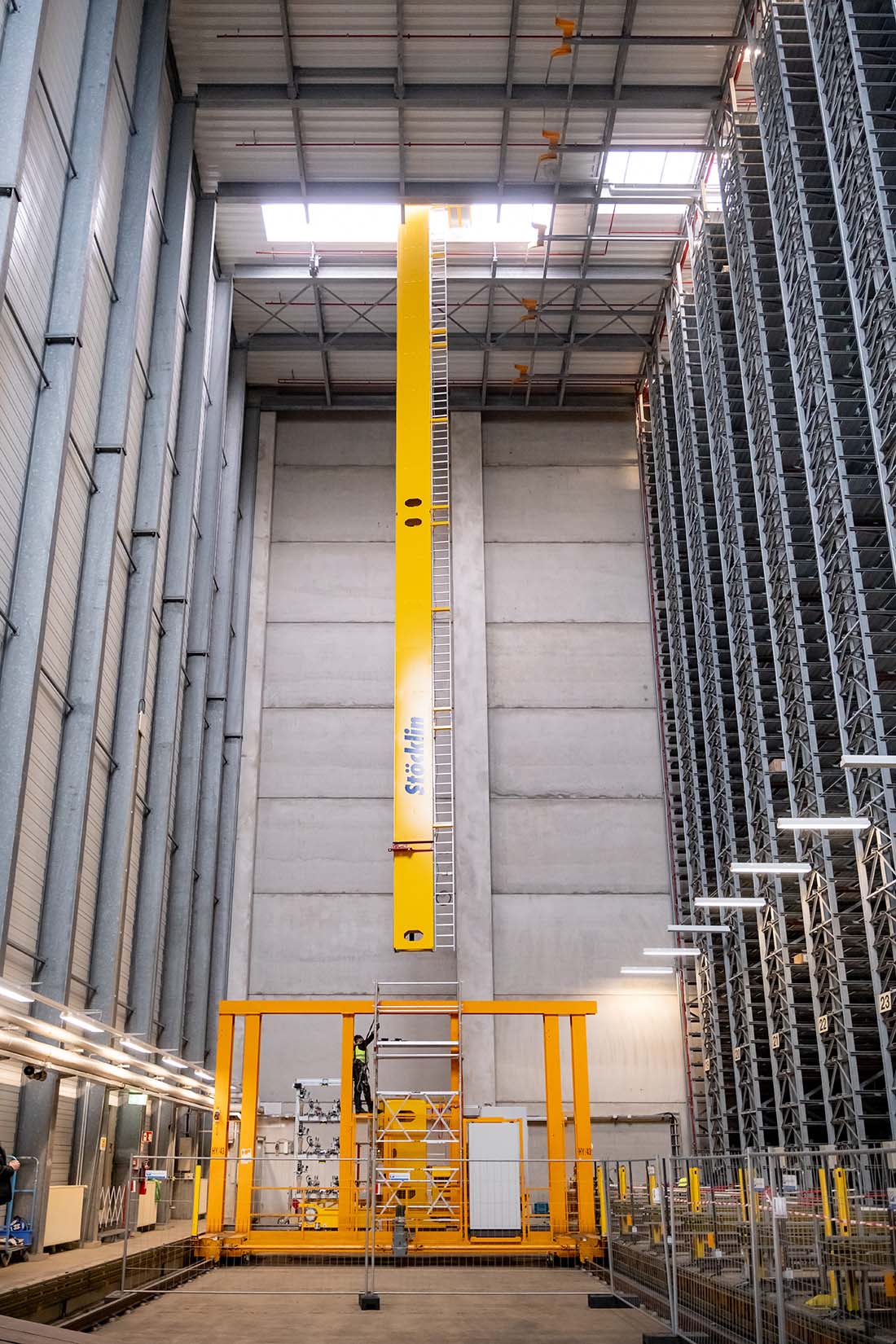
Barbara: The stacker crane is a Stöcklin single-mast unit with an emergency control station, a three-point load-handling device, and a weight of twelve metric tons—which is about four metric tons lighter than the old stacker cranes. The new Stöcklin solutions accelerate much faster and operate at higher speeds. Each unit now serves a single aisle and no longer switches between aisles. In addition, six conveyor levels are installed per aisle, which position the cartons precisely for the stacker crane. People often forget that this is also quite a major undertaking. The focus is often solely on the large machine itself.
Corinna: Thanks to the increased speed, we now have higher throughput and, as a result, improved turnaround times. In addition, overall power consumption is now lower.
Barbara: Since each aisle now has its own unit, more processes can run simultaneously. Previously, we had a problem when cartons for a shipment were located in a neighboring aisle without an RBG; they had to wait for them to be transferred. With 61 units, we can now access every carton directly, which simplifies control. We’re currently using the space freed up by the transfer units for maintenance and repairs. If necessary, however, we could also install shelving in those areas, which would give us 120,000 storage locations on top of the existing 1.2 million—meaning an additional ten percent capacity that could be served fully automatically simply by installing shelving and rail systems. That’s truly enormous.
Apart from installing the equipment, what other special features were there during the renovation?
Barbara: One small special feature is that Stöcklin modified the transfer car and is now using it to pick up the stacker cranes from the roof hatch and move them to their aisles. Once they’ve all found their places, the transfer car is ultimately removed via the roof hatch.
Corinna: We have an incredible number of things running in parallel here, which is often overlooked in large-scale projects like Goliath 61. Right now, we’re also implementing a major digitization project in order picking that affects all departments at the site. This means our operations engineering team, our IT specialists, and our logistics planners are tied up in many projects and processes simultaneously. That’s quite a challenge.
Barbara: Especially since everything is happening while operations are ongoing. It’s a constant cycle of emptying and filling the aisles, which requires a lot of coordination: When are the peak periods? When can the project team get in? When can we run performance tests? Will we get enough boxes into the transfer area?
Although the collaboration is going well, it requires constant communication and, of course, a willingness to compromise here and there.
Corinna: The high-bay warehouse is the heart of our massive distribution center; that’s where it all begins. If something goes wrong there, it immediately affects the subsequent processes. Everything that needs to be implemented there is considered highly critical.
Barbara: Another major challenge is the wide variety of cartons. Our high-bay warehouse stores cartons that come to us from all over the world in a wide range of qualities. While they all have to meet certain standards, even those standards have tolerance limits. On top of that, our cartons are packed very tightly, so we can’t simply use a standard solution with gripper fingers. That makes it even more exciting than just moving small load carriers. Another factor that shouldn’t be underestimated during ongoing operations is safety: Work is being done in one aisle while the stacker cranes are operating right next to it, so we have to be very careful to ensure that the work area is properly secured and that no one strays into an active aisle.
How does Goliath 61 compare to other Otto Group locations? Is it the largest Goliath, or are there bigger ones?
Corinna: At the moment, Goliath 61 is the Hermes Fulfilment Group’s largest ongoing investment. Of course, we’ve invested larger sums in the past—for example, in the complete construction of new facilities. The fact that we don’t stack goods two or three times deep, yet still have 1.2 million storage locations, is what brings us to these 61 aisles. This makes it a mammoth project—and with a height of 27 meters, it’s certainly not standard either.
What is your view on the adaptability of German logistics?
Corinna: We’ve been committed to continuous digitalization for many years. The Group’s strategy also focuses on robotics — specifically where it makes us more flexible and cost-efficient, not just as an end in itself. The combination of a sensible retrofit and increased flexibility for the future is the right strategy for us.
That’s why, for example, we have a strategic partnership with Boston Dynamics and are already using the Stretch robot in goods receiving to relieve our colleagues of the physically demanding task of unloading packages, allowing us to deploy them elsewhere where they are urgently needed. In addition, this is creating entirely new, modern job profiles related to the robots. We’re also using stationary picking robots that, with AI support, pick items from mixed containers. Enormous progress is being made in recognizing items during the gripping process. The technology behind the robotic arm—which has long been in use in the automotive industry—now allows it to correctly recognize and grasp fashion items as well. For our forklift and conveyor fleets, we’re exploring AMR solutions, as there are good, straightforward use cases here where the technology is advanced enough to ideally support our processes.
In summary, we deploy robotics wherever we have repetitive tasks.
We conduct extensive testing and have our own department within the Otto Group dedicated to innovations in this field. Our colleagues are working with great ambition to identify use cases and compare them with suitable solutions available on the market.
In addition, we’re using the Spot robot, which patrols the technical tunnel and monitors indicators there—for example, detecting leaks at an early stage. This isn’t aimed as much at improving productivity as a picking robot would be, but it shows that we’re trying out innovative approaches in every direction.
What are the next steps for you?
Barbara: I’m leaving Goliath 61 with mixed feelings and am looking forward to a new chapter. It was a fantastic project that will certainly continue to run smoothly in the hands of my colleagues following the installation of the pilot stacker crane. For me, the next retrofit project is coming up—an aging replenishment sorter in Haldensleben that distributes cartons from the high-bay warehouse to various final destinations. Goliath 61 was a project close to my heart.
Corinna: I’m staying on the project, as my role remains focused on subject matter expertise and also includes coordination and coaching. I’ll also continue to support the digitization project in order picking that was mentioned. Despite the challenging market, the company is growing, so there’s always a need for good solutions to counter rising cost pressures while still leaving room for growth—so we certainly won’t get bored.
Thank you very much for the interview!
See more interviews in the series
See our other blog posts
Back to the homepage
