

Project Report on a Modernization Project for an Innovative Power Tool Manufacturer
In November 2025, the software modernization project at the warehouse of a leading global supplier of power tools, gardening equipment, accessories, and measurement technology was successfully completed. The distribution center had been the site of a major retrofit project: A low-risk migration to a new Warehouse Management System (WMS) during the ongoing operations of a globally active central warehouse, which handles half of the renowned brand’s worldwide sales across approximately 80,000 m² of logistics space. To minimize risk, TUP applied the so-called “drehregler” principle for the first time.
Initial Situation
The project was initiated by the end of support for the legacy WMS and the desire for flexible, high-performance software. In a joint project involving the tool manufacturer, its logistics service provider, TUP, and the supplier of the legacy WMS, the goal was to replace the existing solution with a modern WMS while the system remained in full operation. In addition, accompanying technical projects had to be completed, including the complete replacement of the middleware connecting to the ERP system and measures in the MFR area. Thus, in March 2019, detailed preliminary planning began for a project spanning several years, designed to accommodate the extensive warehouse automation, complex logistics processes, and the site’s 24/7 operation.
KEY FIGURES
- The central warehouse handles over half of the manufacturer’s global sales.
- An average of 6,000 orders with up to 60,000 line items per day.
- Inbound: 50–100 trucks per day through 37 loading docks.
- Outbound: 30–60 trucks and 40–80 swap trailers per day through 46 loading docks.
- Approx. 80,000 m² of logistics space on 2 levels.
- Storage capacity: High-bay warehouse (HBW) 126,000 pallets, automated small-parts warehouse (AS/RS) 82,500 containers.
- 15,000 rack spaces.
Risk-Minimized Migration via the rotary dial principle
Instead of a traditional “big bang” migration, the customer, together with TUP, opted for a dynamic migration concept that offers maximum flexibility with minimal risk: the “slider.” The idea behind this is that individual warehouse areas and functions are developed step by step and transitioned to the new WMS—in a ratio of old to new system that can be adjusted at any time, from 0 to 100 percent. This ensures that operational control remains reversible when necessary, such as in the event of unforeseen circumstances or peak workloads, as occurred in this project due to the COVID-19 pandemic and the boom in home improvement stores.
At the heart of the concept is the parallel operation of both systems, which communicate with each other via specifically developed interfaces. Depending on the migration phase, one system acts as an “auxiliary” to the currently dominant WMS. This flexible interaction significantly reduces migration risks and allows for continuous validation under real-world conditions.
The control mechanism is strategically implemented wherever a system change would impact delivery capabilities. In less critical areas, a conventional “big bang” migration remains an option. This results in a customized migration path that combines security with agility, enabling a transition—even in highly complex warehouse environments—that goes completely unnoticed by customers further down the supply chain.
Smart, Customized Migration Scenarios
The retrofit project was conceived and planned over the course of several years from the very beginning. “ “Quite a few projects work from a technical standpoint but fail to get people in management, the project team, and the warehouse on board—and ultimately fail because of that,” emphasizes Günther Pfisterer, project manager and Chief Operating Officer at TUP. “Another key to the project’s success is how we broke the task down into phases while also incorporating the personal growth of the people involved in the process,” reports the overall project manager responsible on the tool manufacturer’s side. For the first of four main migration steps (MIG1 through MIG4), the team chose the goods-out (GO) area, which is easier to manage. This atypical sequence allowed the project team to gain initial experience with the migration process using the control dial in an area with manageable consequences, thereby preparing them for more complex steps.
Granular Transfer of Logic and Logistics
The functional migration to the new WMS—a modern logistics application developed specifically for the tool manufacturer—began in 2021, and from that point on, its physical scope of influence continued to expand. The loading of packages was chosen as the starting point for MIG1, which focused on outbound processes. This allowed them, as a very first step, to decide for each individual truck which system should handle the process. From there, the entire complex of warehouse processes was transferred to TUP.WMS in a finely adjustable parallel operation with minimal risk.
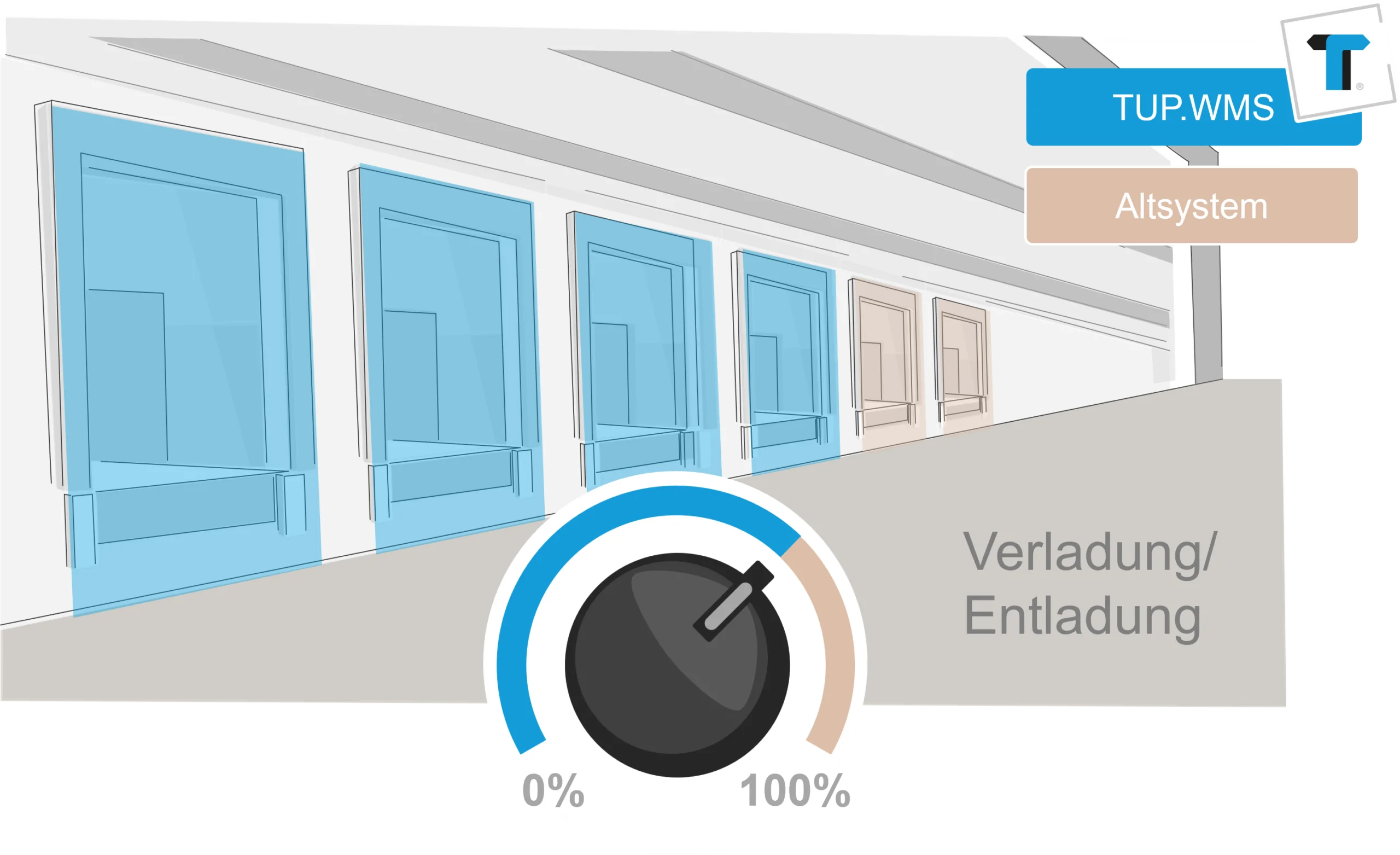
MIG2 covered goods receipt as well as all inbound processes. Similar to MIG1, a control dial was used to first migrate truck-by-truck unloading, followed successively by the putaway strategy, inventory management, and quality management into the new WMS. For the overall warehouse process, this meant that tasks were sometimes passed back and forth multiple times between the new and old WMS. Since returns did not directly impact customers, the company opted for a flexible implementation using the “big bang” approach.
All processes related to customer shipments fell under the complex MIG 3. In several sub-steps, the rotary control principle was able to demonstrate its full functional range:
- The new forklift guidance system was able to take over transport tasks zone by zone via the rotary control—with both WMS systems operating in parallel and working hand in hand.
- Targeted replenishment from the high-bay warehouse to the automated small-parts warehouse (AKL) is another area where the risk was deliberately accepted and a “Small Bang” was chosen—that is, a Big Bang on a manageable scale.
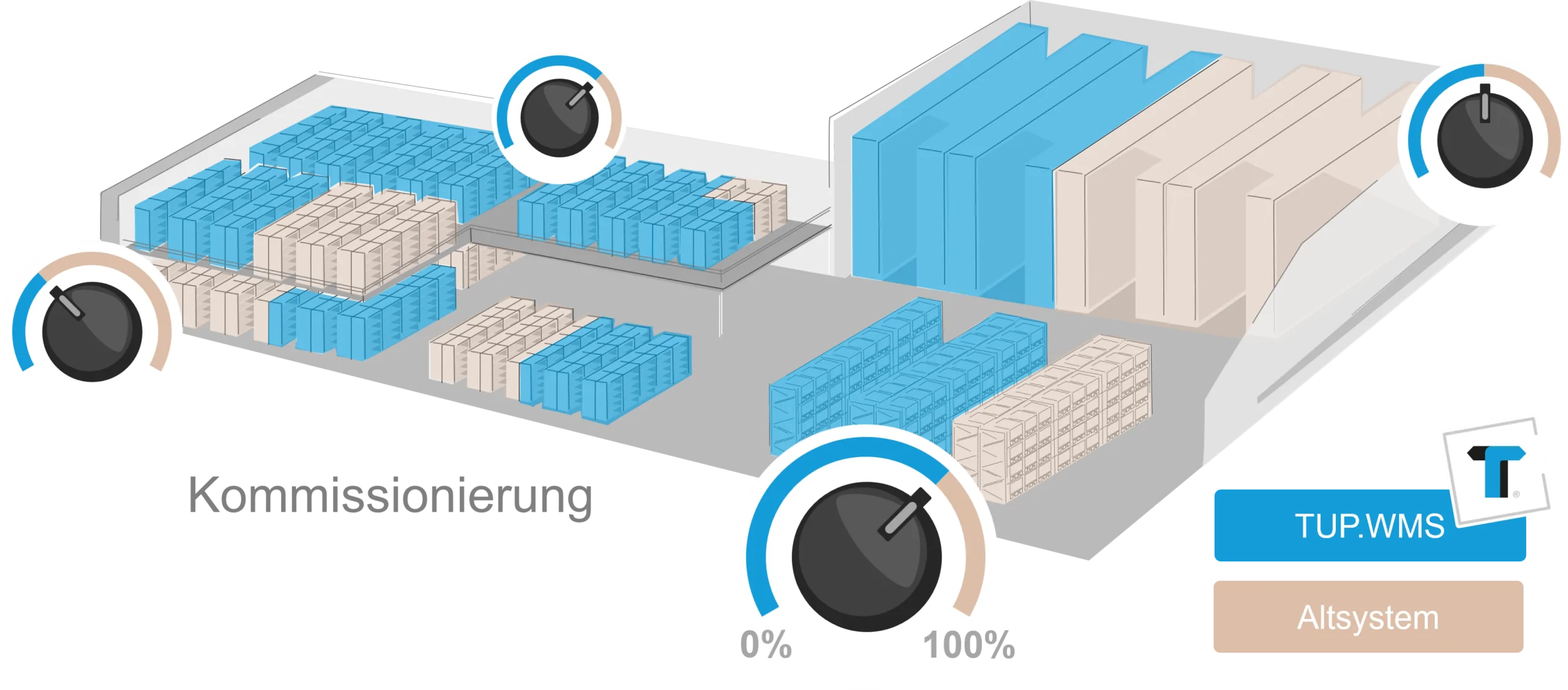
- Picking: Here, the customer and TUP scaled operations across the warehouse floor. Individual packing stations, shelves, rows of shelves, and warehouses—using a slider, picking responsibility could be shifted granularly from the old system to the new one. Operationally, this mirrored the physical flow of goods; much like a to-do list being worked through by two parties, handoffs took place during the migration phase to ensure all items were picked.
- Delivery Control: The complex core of order management—which determines the optimal picking process and scheduling—was achieved through the phased transfer of outbound orders from the legacy WMS.
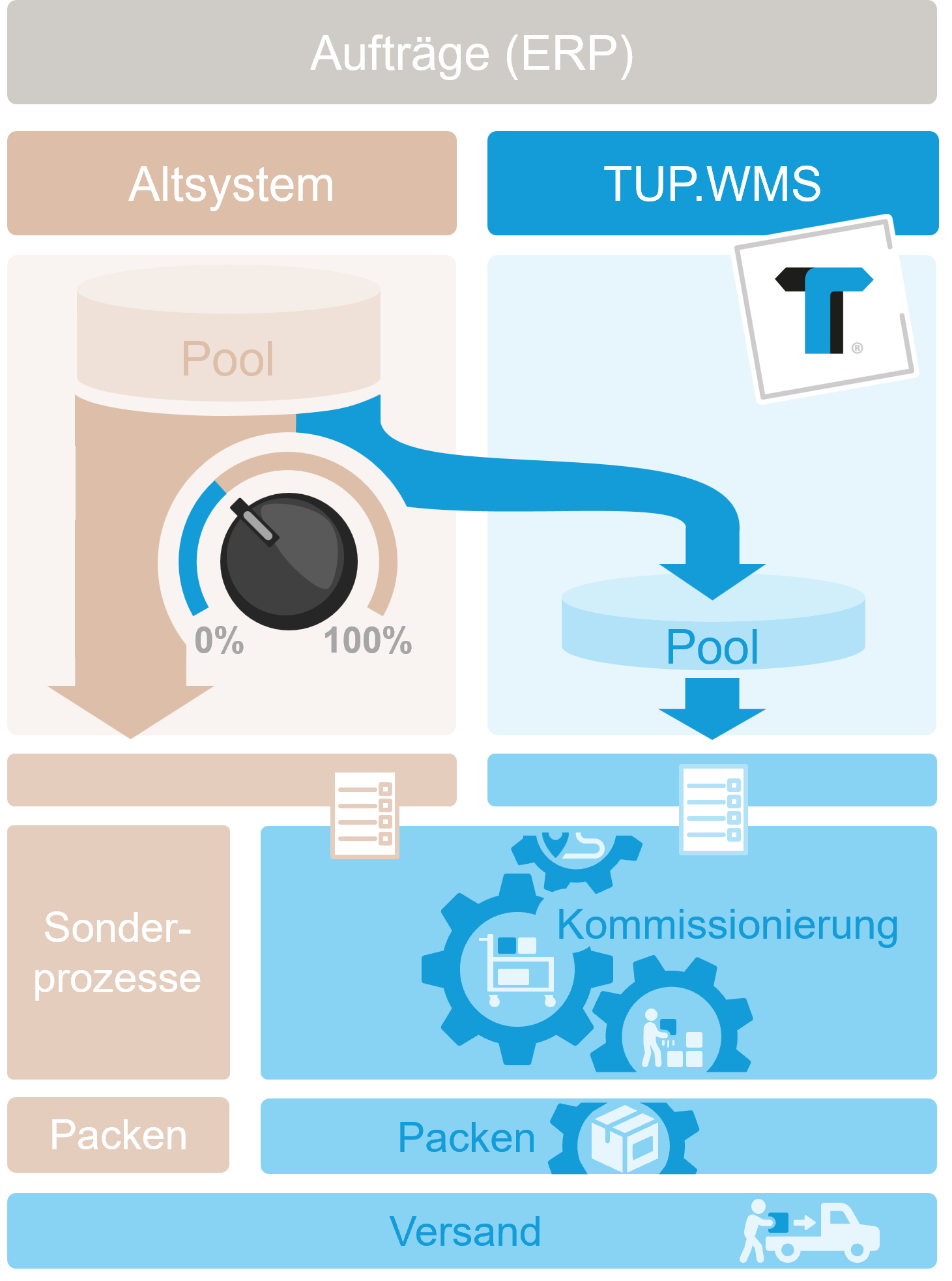
This resulted in the complete replacement of the legacy WMS as the central control system in 2024 and the full implementation of an entirely new load planning logic.
MIG4, the final step in the migration sequence, covered remaining functions and special processes and was completed in 2025. Since then, TUP’s WMS has been operating 100% independently.
The Control Knob as a Guarantee of Success
The control knob proved particularly valuable during times of crisis by enabling spontaneous rollbacks to the legacy system and adjustments—a key factor for a zero-downtime migration. During the COVID pandemic, for example, the company once had to compensate for the absence of an entire shift due to illness. The additional burden of the migration on the remaining staff was minimized by switching to 0% use of the new system. This migration approach enabled the globally renowned company to continue its operations seamlessly. This fallback strategy was also used to meet urgent customer requirements in the company’s B2B business. The IT project manager at the tool manufacturer emphasizes: “The ability to proceed in this way demonstrates the immense strength that incremental migration with the ‘control knob’ offers in critical moments.”
Migration as a Driver of Innovation – A Transferable Model
The migration demonstrates how technological renewal and operational continuity can be reconciled—even under the most challenging conditions. This was made possible by closely integrating agile software development with incremental migration during live operations. TUP developed fully functional modules across multiple parallel development streams, which were tested for practical suitability in over 1,000 automated tests per release—an approach that kept complexity under control and guaranteed maximum operational reliability.
The “control knob” principle has proven itself both as a tool for minimizing risk and as a strategic concept for transformation under full load. Instead of a monolithic migration involving downtime, it allows for flexible control of system responsibility—including the temporary rollback of individual functions. For the customer, this meant: stable operation even under pandemic conditions, rapid response to customer requirements, and sustainable knowledge-building within the team.
The project thus provides a robust model for anyone seeking to modernize existing IT structures in highly automated warehouse environments without downtime—and demonstrates how well-designed software architecture can become a true driver of innovation.
“The ‘rotary dial’ approach is a risk-minimized, controlled, and manageable ramp-up that you can adjust at any time according to your own confidence level—and scale back to zero if necessary. This significantly reduced stress levels for everyone involved. For me, having already gone through many ‘big bang’ implementations, these were the most relaxed ramp-ups ever. Thanks to the consistently available delivery capacity, issues that inevitably arose could be resolved in a structured manner without creating additional potential for disruption elsewhere.” – Client-side Project Manager
