



The so-called block heuristic comes in various forms and refers to a mathematical method for optimizing the packing of (pallets, containers) containing highly heterogeneous items. For packing optimization, finite combinations are simulated using packing patterns with different items. The result is an optimized packing strategy, which, however, may be – and usually is- adjusted manually by the packing employee. From a bird’s-eye view, this optimization resembles the computer game Tetris.
To make optimal use of the packing space during pallet or container loading, a block heuristic is often used today. This is typically a computer-aided calculation that provides a recommendation for very good utilization of the given packing volume. However, it usually deviates from the optimal solution. Reasons for this include: poorly organized packaging standards (irregular shapes), defective packaging, faulty processes, human error, and incorrect master data in the warehouse management system (WMS) or ERP system. Ultimately, all of these factors reduce the desired quality of the heuristics – so people try to combine the computer-generated recommendations with their cognitive abilities.
Employees’ cognitive abilities come into play, for example, when packages have a specific shape. In such cases, stacking and nesting can be utilized—techniques that the calculation method often does not account for. A preliminary and automatic volume measurement of packages and pallets can therefore be advantageous.
Reasons for a computer-aided recommendation:
- Reduction in required storage space
- Reduction in transportation costs
- Reduction in material waste
Packing strategies and influencing factors
While processing the shipping order, employees at the distribution center use the warehouse management system to ensure that the number of loading units created is minimized. In addition, in today’s intralogistics, it is advantageous to arrange the order of items during packing in such a way that it causes no delays during unpacking, for example, at the retailer’s location. For instance, pallets are assembled according to department. Product groups, for example, can be used for this sorting.
Packing optimization is generally complicated by the influencing factors mentioned above. These include, among others,:
- Weight and load capacity of the goods
- Stability of the individual package as well as the loading unit
- Unpacking process for individual items or product groups
- Design/form factor of the individual packages
Note: As a rule, one attempts to orient the longest side of the package parallel to the container walls or pallet sides. Diagonally packed packages should be avoided, as they block usable space (see the illustration provided). A completed block should not be formed as a column or tower, as individual packages are unstable. To avoid stacking in a tower as much as possible, efforts are made to stack the packing blocks or packages in a connected manner (see the illustrations shown). With blocks, it is also easier to ensure the necessary stability than with individually stacked packages.
Over time, the countless packaging variations and materials, as well as the increasing demands at individual distribution centers, have led to the practical application of various block heuristics. These are also referred to as n-block heuristics. The “n” stands for the many possibilities offered by different heuristics.
The number of individual blocks in which the packages are stacked defines the heuristic being used.
Examples of Block Heuristics
- 4-Block Heuristic
- 5-Block Heuristic
- 6-Block Heuristic
- 7-Block Heuristic
Example of 4-Block Heuristic
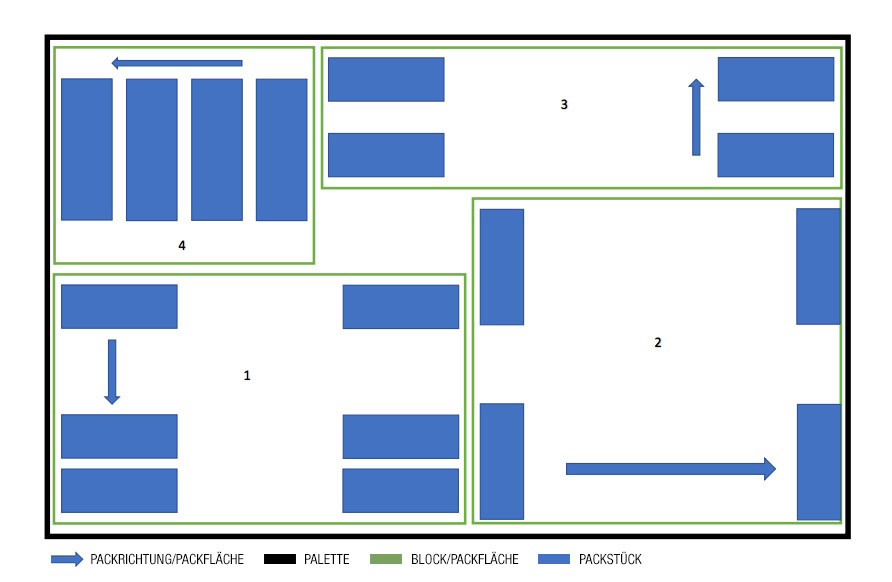
In the 4-Block Heuristic, the packing area is formed from a maximum of four large blocks (green).
The four blocks must not overlap. For example, the first block is placed lengthwise at the lower left corner of the packing area. The second block, of similar dimensions, is placed at the lower right and, like the packages themselves, runs parallel to the short side of the pallet as it extends upward. The packages themselves are always positioned in relation to one another, stabilizing each other, and must take the aforementioned influencing factors into account at all times, for example during palletizing. The more complex the heuristic becomes, the more heterogeneous the packages involved typically are.
Important: As a rule, one block is always packed completely first. The other blocks are oriented according to this one, especially when it comes to the height of the stack. The rule is: Always place the heavy packages at the bottom and distribute them evenly across the loading area.
There are three main processes for optimally packing pallets or containers. However, the examples that follow often differ in practice and are intended merely as a guide to how packing optimization might proceed.
Example of automated packing using computers and robots
The employee enters the order number to be processed into the computer and then selects the packing method (packages on a pallet, 1-7-block heuristic, or other packing variants). This is followed by information on the type of pallet used (dimensions) as well as key data on the packages themselves. The latter is typically handled via scanning beforehand (during packing) or provided by the ERP or WMS (see also Inventory Management). This is followed by confirmation of the calculation. Once the calculation is complete, a packing robot begins stacking the packages onto the pallet.
Example of palletizing where machines and humans work together
Compared to the first example, the employee here takes on the level of automation described above—or the automated processes—and handles the packing optimization manually. In doing so, they either view the computer-generated recommendations on a screen or use a printout. In the machine-human variant, the packer can rely on their own cognitive abilities and decide whether to follow the system’s recommendations or adjust them manually.
Example of manual packing, in which only humans are involved
The employee decides how to assemble the pallet as they pack. Packing optimization is based on their experience. The manual approach is still practical—and the more cost-effective alternative—especially for smaller warehouses and lower order volumes. Furthermore, it does not necessarily have to be slower than automated packing optimization
Summary
Block heuristics are used to find optimal solutions for complex packing and stacking processes. The level of complexity of the heuristics develops automatically based on the packages and the planned packing blocks. The computer-generated recommendation is rarely the optimal solution; rather, the employee also uses their cognitive abilities to ensure the perfect packing optimization in the end.
For more information on packing optimization, see Sorter (Packing) – Key Metrics and Sorter (Packing) – Packaging.
Teaser image: Nordpack GmbH
