

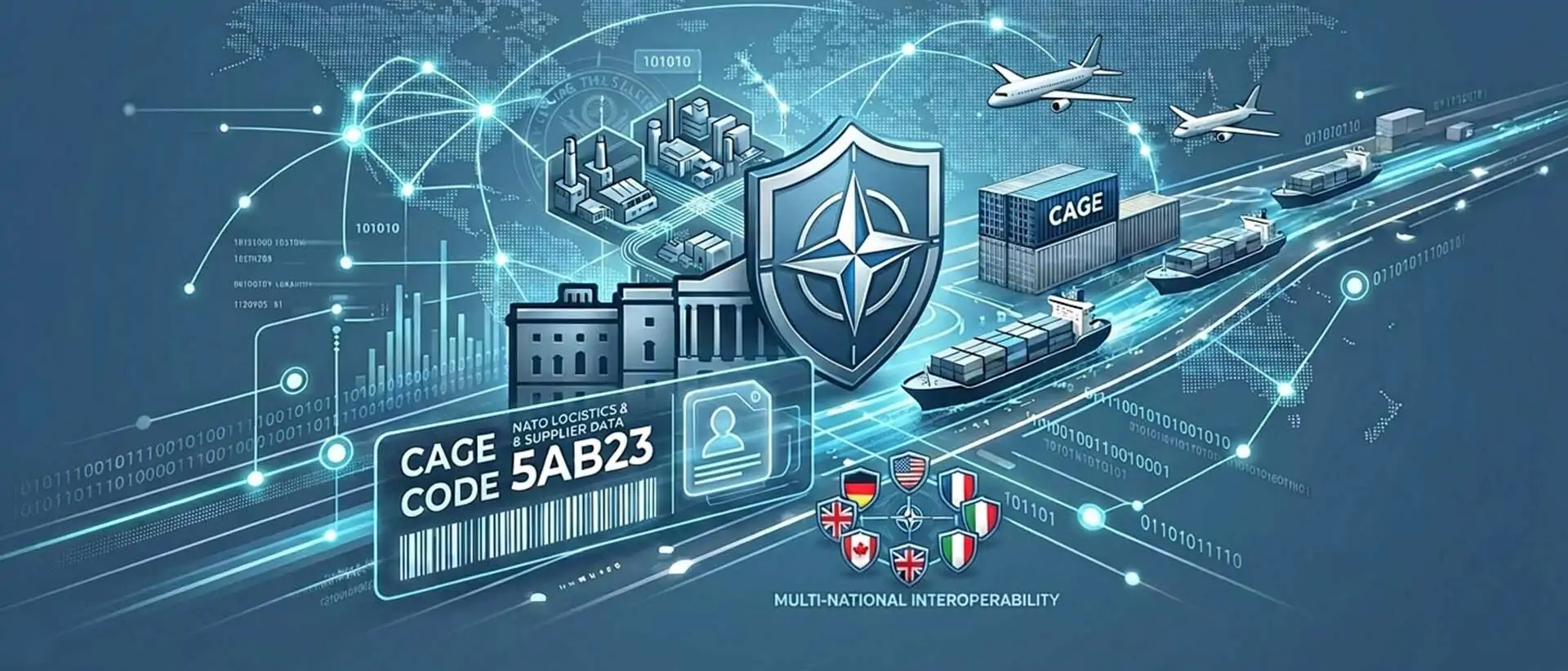
The term “CAGE Code” is most commonly encountered by companies in international trade, the defense industry, aerospace, and, increasingly, in globally interconnected supply chains. Although many companies outside these industries initially have little contact with it, the code plays an important role in the unique identification of companies and suppliers. The topic is gaining particular significance in the context of modern intralogistics and digital supply chains.
What is a CAGE Code?
The CAGE Code is a standardized identification code for companies and organizations. The abbreviation stands for:
Commercial and Government Entity Code
It is a five-digit alphanumeric code that can be used to uniquely identify companies worldwide. The system originated in the United States and is administered by the U.S. Department of Defense. The initial goal was to uniquely register suppliers in military procurement.
Today, however, the CAGE Code is used far beyond military applications. Among other things, it serves:
- supplier identification
- the management of international supply chains
- the standardization of company data
- the unique assignment of spare parts
- the traceability of logistics processes
- the simplification of electronic procurement systems
For companies outside the U.S., there is often the so-called NCAGE code (“NATO Commercial and Government Entity”). This is used within NATO countries and serves the same purpose.
Structure and Syntax of the CAGE Code
The standard CAGE code consists of five characters. These can consist of numbers and letters.
Examples:
- 1A2B3
- 7X9F1
- D1234
The syntax does not follow any freely chosen rules of the company, but is assigned by the responsible issuing authority.
Basic Structure
The code has:
- exactly 5 characters
- alphanumeric characters
- no special characters
- no spaces
Formally, the syntax could be simplified as follows:
[A-Z0-9]{5}
This means:
- uppercase letters A–Z
- Numbers 0–9
- exactly five characters
An example:
CAGE: 4K2L8
Each character combination serves solely for identification purposes. Unlike some product numbers or barcodes, the characters themselves do not typically contain any readable information about location, industry, or product group.
Difference between CAGE and NCAGE
The term CAGE is often used generically, but there are actually two main variants:
| Type | Meaning | Area of Application |
| CAGE | Commercial and Government Entity | USA |
| NCAGE | NATO Commercial and Government Entity | NATO member states |
A German company that, for example, supplies components to NATO partners often requires an NCAGE code.
In Germany, codes are assigned by national authorities or NATO-affiliated registration offices.
Why are CAGE codes important?
- Unique identificationCompanies can be uniquely identified worldwide. This prevents confusion with company names that sound similar.Example:
- Müller Industrie GmbH
- Müller Industrie Systeme GmbH
- Mueller Industrial Solutions Ltd.
With a CAGE/NCAGE code, these companies can be clearly distinguished.
- International Supply ChainsGlobal supply chains consist of thousands of suppliers. The CAGE code provides a standardized reference here.This is particularly important for:
- Aviation
- Automotive
- Defense
- Mechanical engineering
- Electronics manufacturing
- Digitization of procurement processesModern ERP systems, procurement platforms, and electronic marketplaces use standardized identifiers.The CAGE Code is frequently integrated into:
- Supplier master data
- EDI processes
- SAP systems
- Materials management
- Maintenance management
Role of the CAGE Code in Intralogistics
- Traceability of ComponentsIn automated warehouses, parts must be uniquely identifiable.For example:
- Which supplier produced the part?
- Which batch was delivered?
- In which system was it installed?
Here, the CAGE code can serve as part of the master data.
- Integration into barcode and RFID systemsMany industrial identification systems include supplier references.The CAGE code can be integrated into:
- Data Matrix codes
- QR codes
- RFID tags
- Serial number systems
This enables automated identification within intralogistics processes.
- Automated warehouse managementWarehouse management systems (WMS) process huge amounts of data today.A typical data record might contain:Item number: AX-4588
Supplier: 4K2L8
Batch: B2026-118
Storage location: H12-04-08The CAGE Code serves here as a unique supplier identifier. - Spare Parts ManagementSpare parts management is particularly critical in industrial facilities and automated conveyor systems.Standardized supplier identifiers enable:
- Faster procurement of spare parts
- Unique identification of suppliers
- automate international orders
- Connection to NATO and Defense LogisticsHistorically, the CAGE Code originated in military procurement. There, the unique identification of components is particularly important.A military vehicle can consist of thousands of individual parts sourced from different manufacturers. The CAGE Code makes it possible to track:
- which manufacturer was involved
- when the part was produced
- which specifications apply
- which spare parts are compatible
These principles were later applied to civilian industries.
Differences from Other Identification Systems
The CAGE code is often confused with other numbering systems.
| System | Purpose |
| CAGE/NCAGE | Company identification |
| GTIN/EAN | Product identification |
| DUNS | Company creditworthiness and registration |
| ISBN | Books |
| VIN | Vehicle identification |
The CAGE code therefore primarily identifies the organization—not the product.
Conclusion
The CAGE code is far more than just a technical identification number from the military sector. It serves as a central mechanism for the unique identification of companies within international supply and procurement processes.
Especially in modern intralogistics systems, the precise mapping of suppliers, components, and material flows is playing an increasingly important role. Due to the growing digitalization of warehouse management, ERP systems, and automated supply chains, the CAGE Code is therefore gaining significance even outside of traditional defense industries.
Companies that operate internationally or manage complex supply chains benefit from standardized identification systems such as the CAGE or NCAGE code—particularly in terms of transparency, automation, and traceability.
