



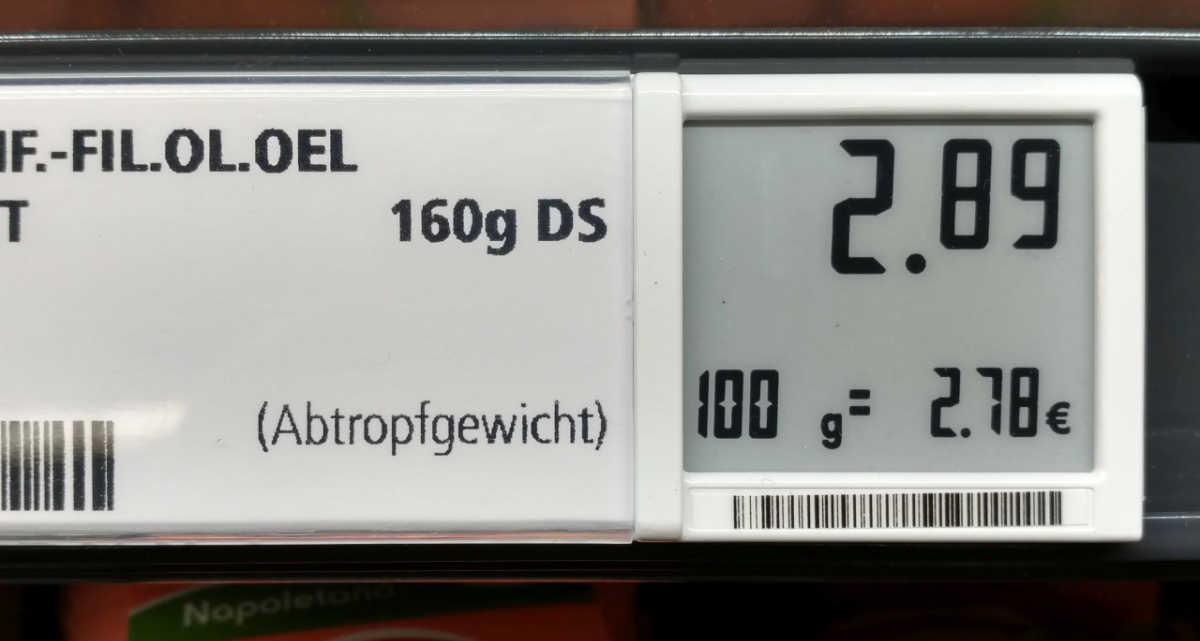
An electronic shelf label (ESL), also known as a digital shelf label or, more commonly, an electronic price tag, displays the price of an item on a digital screen in retail stores. The shelf label is typically placed at the front of the shelf where the item is stocked.
Electronic shelf labels are part of an integrated IT system and automatically and instantly display item prices, which are controlled by a central server and adjusted by authorized personnel.
ESL modules use technologies such as e-paper (Electronic Paper) or LCD (Liquid Crystal Display) to display the current price of an item; however, dot-matrix technology is considered the technology of the future, as it offers a display capable of processing significantly more graphic elements. In addition to prices, this allows for the display of product descriptions, graphics, images, QR codes, and barcodes. Price changes are automatically updated via a specialized communication network that meets the most important user requirements thanks to its key advantages. For example, wireless communication must bridge long distances while providing an appropriate transmission speed (similar to real-time). Wireless transmission can take place via radio waves, infrared waves, or even visible light waves. As of today, the ESL market tends to rely on either high-frequency-based solutions—i.e., radio waves—or Wi-Fi and Bluetooth technologies. However, the latter technologies are susceptible to interference in the technological environment (frequencies).
How It Works / Structure: Electronic Shelf Label (Infrastructure)
Typically, an ultra-low-power CPU is integrated into the label itself, along with a wireless communication solution that includes server infrastructure. An ESL system offers various application options depending on the existing infrastructure (IT and number of retail locations). For example, there are so-called on-premise solutions, which are suitable for providers with few retail locations; conversely, there are cloud solutions that can manage multiple stores—both variants can usually be combined.
In the local variant, a locally stored merchandise management system (MMS) or ERP system is used to consolidate price data and other information, whereas in a cloud solution, a central WMS/ERP handles the transmission of the consolidated data to an ESL server. It is important to note that the cloud solution itself can also be located within a central corporate network, to which the ESL infrastructure of the respective stores or the respective store is then connected.
In summary: The WWS or an ERP system sends the processed product information to a central ESL manager or ESL server. This can be hosted either in the cloud or on-premises. The ESL server, in turn, sends the information to the individual stores according to predefined settings, where hardware components such as labels, smartphones, and PC units are interconnected and communicate with one another, including the connected ESL system.
Electronic shelf labels and their associated hardware and network components are divided into three functional areas:
-
- The label management software: Among other things, it configures the core system and handles the settings for the label itself. It also handles database updates for price lists and maintains data communication between the label management software and the shelf labels. Through an integrated user interface, the user can upload information to individual shelf labels. However, database updates and price lists can also be managed centrally by a WWS/ERP system.The label management software thus provides an overview of the system and provides feedback on the status of all tasks. Furthermore, the software controls the transmission of product data to the shelf labels by compressing the relevant data sets—such as price, logo, and product information—and forwarding them in a system-specific format.
- The communication transmitter: The radio module ensures stable and reliable transmission over a long distance from the label management software (within the ESL server) to the shelf label—however, the price can also be entered locally at the point of sale (via PC, smartphone, or tablet). Example: If fruit needs to be sold in the evening at a store in a retail chain, a local price adjustment is usually sufficient. The central WWS/ERP system is merely notified. Consequently, a commercial inventory reconciliation does not take place simultaneously. To ensure that the control server automatically recognizes the transmission of the price update as complete, receiver elements built into the shelf labels send a confirmation signal back to the central control server—though this depends on the label hardware used.
- The shelf label: It consists of a display and a receiver unit; to enable feedback to the control server, a transmitter unit is required—this varies by vendor. In addition to displaying the price, the built-in wireless module establishes a connection to the control server and maintains it during the transmission process.
ESL Software Functions in Detail (Source: Bison-Group)
System Functions
- Management of product/label mapping
- Product price and information database
- System infrastructure configuration and control
- Interface to third-party systems, such as inventory management
- Processing of imported product data
- Template management
- Monitoring
- User management
Operational Functions
- Advanced system monitoring (radio signal quality, battery status, temperature, error message analysis)
- System statistics (number of product imports, number of price changes, and much more)
- Successor Article
- Shelf Location Recording
- Returns Management for Defective Labels
- Power Consumption Optimization
- Label management (active, defective)
- API for external monitoring tools
Price changes in retail are becoming increasingly dynamic.
Forecasts predict up to 5,000 price changes per week within the next three years. The reasons for the increasing number of price changes lie both in competition with online retailers and in efforts to reduce markdowns on unsold or perishable goods.
Bison Deutschland GmbH / Why ESL / Europa3000.ch
Editor’s note: To account for logistics in addition to store logistics, an interface with the merchandise management system also makes it possible to respond to price changes directly from the functions of procurement, transportation, warehousing, order picking, and shipping functions to adjust prices.
Advantages and Disadvantages of Electronic Price Tagging
Electronic shelf labels are primarily used in retail at the POS; currently, this is particularly common in large supermarkets and electronics stores. As mentioned at the beginning, they are typically attached to the front of the corresponding shelf and display the product’s price; additionally, other information can be displayed, such as the best-by date, price relative to a reference quantity, inventory levels, or specific product details.
Advantages of Electronic Shelf Labels
An automated system of electronic shelf labels reduces labor costs associated with manual price labeling. It also improves the accuracy of price labeling and enables dynamic pricing. The latter, in particular, allows for rapid price adjustments based on demand, online competition, inventory levels, shelf life, and promotional campaigns. In summary, the advantages include:
- Accurate price labeling
- Cost savings (labor)
- Locating shelf locations (e.g., identification using color codes)
- Regulating shelf inventory
Disadvantages of Electronic Shelf Labels
On the one hand, the accuracy of price labeling is significantly improved, as the need for human labor to label prices manually and individually is reduced to nearly zero; on the other hand, however, a single error at a central location leads to the widespread dissemination of an incorrect price label—potentially across the entire retail chain.
Another disadvantage is the high investment costs associated with the initial implementation of such an electronic price-tagging system; likewise, its profitability is difficult to calculate or quantify. In summary, the disadvantages include:- Central errors lead to far-reaching consequences
- High investment costs for initial implementation
- The system’s profitability is difficult to quantify
Summary: Electronic Shelf Labeling
Electronic price labeling refers to a communication system, primarily used in retail, that enables prices to be changed from a central location. This allows prices to be automatically updated in real time across all stores in a retail chain, eliminating the need for staff to manually replace and attach paper price tags. The price is displayed on an electronic shelf label, which typically receives a radio signal from the control server and can display additional product information in addition to the price. According to woutex.de, in addition to traditional retail chains, ESL software is used at gas stations, car dealerships, and, for example, pharmacies.
Teaser image: Franklin Heijnen / CC BY-SA 2.0
