


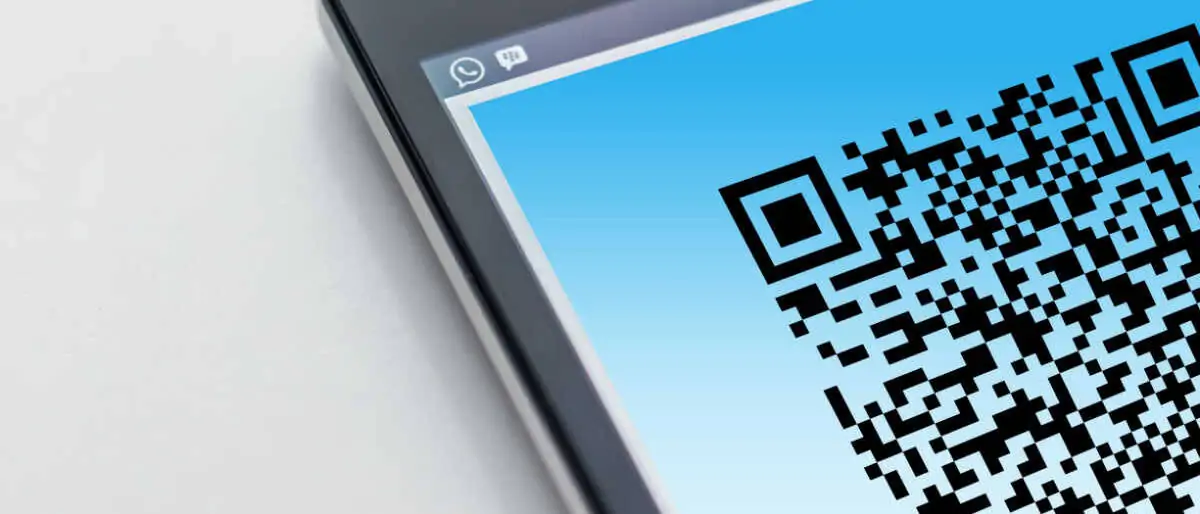
One-dimensional barcodes are commonly used to label goods and services. However, since the data density of such codes is low, applications designed for this purpose use two-dimensional codes (2D codes or 2D barcodes), whose data capacity exceeds that of conventional barcodes by a factor of many.
Two-dimensional codes are therefore used when a larger data capacity is required than what one-dimensional codes can provide. There are two main groups of two-dimensional codes: stacked codes consist of stacked, one-dimensional barcodes, while matrix codes consist of square or rectangular patterns.
Stacked codes
Unlike one-dimensional barcodes, stacked codes consist of a two-dimensional bit pattern that, as mentioned above, has a square layout. Stacked codes utilize both the X-axis and the Y-axis within their area, and by stacking multiple rows of one-dimensional barcodes within this area, the amount of data that can be stored is significantly increased. The number of characters that can be stored is calculated by multiplying the capacity of a single line by the number of lines. Slightly modified laser scanners can be used to read these stacked codes; in simple terms, the image of the 2D barcode is scanned and decoded using image processing software. In addition to industrial handheld devices and so-called MDE devices (see also Pick-by-Scan), smartphones can also read such codes. Examples of stacked codes include PDF417, Codablock, Code 49, and Code 16K.
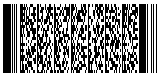
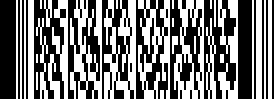
Advantages and Disadvantages of Stacked Codes
- The advantage of stacked codes is that the area required for the code can be kept relatively small due to the stacking. As a result, compared to one-dimensional barcodes, more information can be accommodated per unit area. Consequently, if the code is printed at high resolution, the physical size of the code can also be significantly smaller—keyword: space-saving.
- The disadvantage is that it requires more sophisticated reading technology (see also CCD camera) compared to standard barcodes. In practice, scan times can have a negative impact on subsequent workflows, for example, within order picking. However, if the code structures of standard barcodes are retained and the reader operates according to industrial standards (a proper scanner instead of a camera), this additional effort is minimal.
Matrix Codes
Matrix codes were developed alongside barcodes. This type of code requires sophisticated reading technology. A matrix code is composed of various geometric shapes, most commonly dots, rectangles, and hexagons. Examples of matrix codes include DataMatrix, MaxiCode, AztecCode, and QR Code.
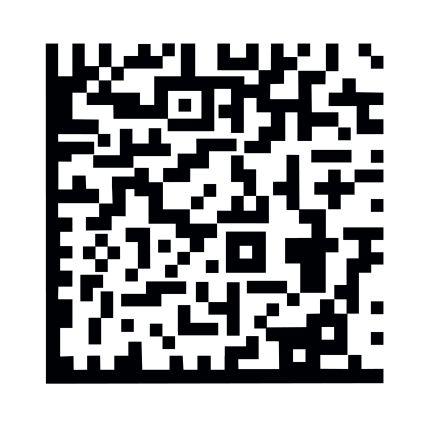
Advantages and Disadvantages of Matrix Codes
- The advantage of matrix codes is that the area required for the code can be kept relatively small, allowing more information to be stored per unit area compared to one-dimensional codes. The code is also readable from any angle of rotation. Compared to stacked codes, the code size is smaller while containing more information.
- The disadvantage is that matrix codes require camera-based image processing systems to decode them. Furthermore, two-dimensional codes generally place higher demands on printing technology. A major stumbling block to the widespread adoption of these codes is still the lack of standardization, though this is being addressed step by step, both on a country-specific and cross-border basis; for example, the “QR Code” matrix code has become a national standard in several countries.
QR Code
A QR code belongs to the group of matrix codes. QR stands for “quick response.” Using this two-dimensional code, users can be directed to text and other multimedia content in a format optimized for devices such as smartphones. Typically, a specific app—such as a web browser—opens based on a command embedded in the QR code.
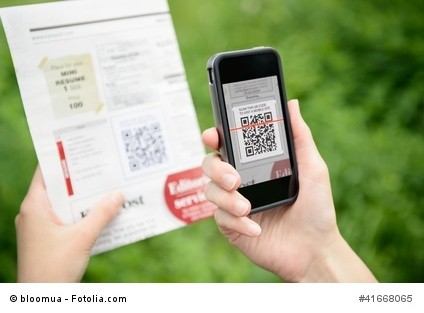
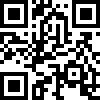
It consists of light and dark modules that together form a square matrix. Exactly eight modules make up a code word. These modules do not necessarily have to be black or white; what matters is that there is a high contrast between the light and dark modules. The so-called “finder patterns,” located in three of the four corners, make it possible to recognize the code as such. They are always placed in the same locations within the QR code and thus determine the code’s orientation. A “finder pattern” is always seven modules wide. Visually, a line—known as the “timing pattern”—runs between these three markers.
Thanks to a built-in error correction mechanism, a QR code can still be read even if it is not 100 percent legible or is slightly dirty. This allows the code to be decoded even with up to 30 percent of the data missing. However, the higher the error correction level, the less data the QR code can hold.
While, as mentioned above, it has already been adopted as a national standard in several countries, the QR code has also undergone several technical advancements:
- Design QR Code (also known as a Custom QR Code, customized with graphic elements such as a logo, text, or image; adapted to corporate designs and used in marketing campaigns; takes advantage of the QR code’s error tolerance)
- Micro QR Code (a QR code variant optimized for minimal dimensions)
- Secure QR Code (SQRC, includes a function for encrypting data content)
- iQR Code (can also be rectangular in shape and, for example, applied to a cylindrical object; similar to the Micro QR Code, it offers high data density in a very small space)
- Frame QR Code (used for incorporating graphic elements, similar to the Design QR Code; however, rather than utilizing or compromising error correction, it creates a blank area around which the actual QR Code is placed; this blank area can then be graphically designed; the Frame QR Code is not compatible with conventional QR codes and requires a different app to be scanned)
Data Matrix Code
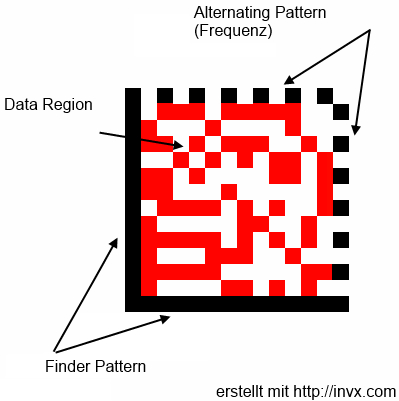
Along with the QR code, the DataMatrix code is one of the best-known 2D codes and has become particularly established in industrial production, where it is applied as permanent marking via laser or needle embossing to identify individual components. However, it is now also used in document handling as a printed code image, such as by Deutsche Post or the pharmaceutical industry in the example below.
The following video gives an idea of just how small DataMatrix codes can be.
Like the QR code, the DataMatrix code features error correction; it can be either square or rectangular in shape and can also be placed on and read from cylindrical surfaces. The DataMatrix code is defined in the international ISO/IEC 16022 standard, and is used in its variant with ECC200 error correction (Reed-Solomon algorithm) is used in conjunction with the GS1 data structure. This has given rise to the term “GS1 DataMatrix,” which, however, does not describe a specific code but rather the configuration of these components. It is both its technical properties and its international standardization that continue to drive the widespread adoption of the DataMatrix code.

Applications
Editor’s Note: The use of multidimensional codes, particularly QR codes, should be viewed in a broader context—that of mobile data capture, which also includes RFID systems.
In many areas of logistics, there is a need to reconcile the location, logistics status, and identification of a product or a means of production. Mobile data capture is particularly helpful in this regard.
seton.de
QR codes were originally used in production logistics but have since become part of everyday life. In logistics, or more specifically in material flow, the classic barcode is still used extensively; however, it is often needed only for identification, while the actual information is stored in other systems (ERP system, warehouse management, merchandise management system). Nevertheless, it is matrix codes such as QR codes and DataMatrix codes that offer tremendous potential for innovation. For example, stationary printers can now quickly apply codes to packaging to uniquely identify the goods. The batch numbers traditionally used are being replaced by assigning a serialized identifier to each individual package; this is successfully practiced, for example, in the pharmaceutical industry for medication packaging. The much greater information capacity of such codes simplifies documentation on the one hand and makes business processes audit-proof on the other. Furthermore, it has now become standard practice to combine different code variants.
Example: SecurPharm
On February 9, the new security system for pharmaceuticals, “securPharm,” went live. The German organization of the same name, securPharm e.V.—initiated by the industry, wholesalers, and the pharmacy profession—developed this system in accordance with the requirements of the EU Falsified Medicines Directive 2011/62/EU. Packages of prescription drugs that manufacturers place on the market will henceforth feature two additional security features, which are verified directly before dispensing to the patient.
This EU directive stipulates that each package must have a so-called unique identifier, consisting of a product code, serial number, batch number, and expiration date, printed as a 2D barcode. Furthermore, each package must be sealed to determine whether it has ever been opened. From a data processing perspective, these packages must be verified end-to-end. This means that when a package is produced, the manufacturer uploads the unique identifier data to an EU-wide database. When the package is dispensed to the end user, it must be marked as dispensed in the database. Between the manufacturer and the end user, the package can be verified as often as necessary. This involves querying the database for the unique identifier to verify both that it exists and that it has not yet been marked as sold. A traditional barcode would be far too large to accommodate this amount of information, which is why the data mentioned above is encoded in a DataMatrix code (ISO/IEC 16022).
Summary of Two-Dimensional Codes / 2D Codes
Multidimensional codes (also known as two-dimensional codes or 2D codes) have a significantly larger data capacity than one-dimensional codes; they are divided into stacked codes and matrix codes. The QR code is one of the most widely used and well-known matrix codes, as it can be both created and read without specialized technical knowledge or complex tools, while offering a balanced ratio of space to data capacity. Compared to the classic barcode, the QR code also features a high error tolerance, allowing it to be read even if it is damaged. For example, QR codes are used just as efficiently in warehouse management as they are in everyday life or in advertising. The DataMatrix code has also become established through users such as Deutsche Post, where it is used for computer-generated postage.
