


Interfaces serve to connect IT systems to their environment—that is, to other systems, facilities, or subsystems. In the field of programmable logic controllers (PLCs), the connection between the PLC and its environment is often established by communication processors (interface controllers). These modules act as intermediaries between the PLC and its peripheral components (sensors, actuators, devices).
Innovative control approaches in warehouse management, where a material flow computer (MFR) processes a large number of different sensors and actuators simultaneously and in a fraction of a second, pose new challenges for modern bus systems and their interfaces.
Tasks for Interfaces in Warehouse Management
- Buffering of input and output data
(e.g., cyclic program execution in the PLC)
- Data conversion
At the interface to peripheral devices, a wide variety of transmission types (e.g., serial, parallel) and data formats (e.g., data transfer between the CPU and the communication processor (=interface controller) of a PLC) must be handled.
- Generation of control and handshake signals
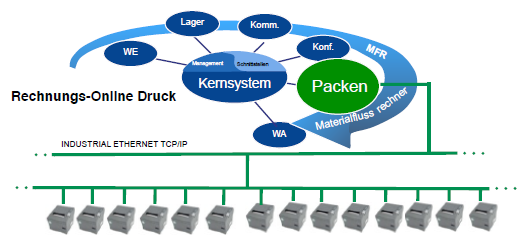
To synchronize peripheral components with the warehouse management computer, control and handshake signals are required (e.g., to ensure that an invoice is not printed twice during online invoice printing)
For more information on warehouse planning, see The Basics of Warehouse Planning – Defining Objectives.
For more information on communication via a local area network (LAN) , wide area network (WAN) or mobile networks can be found at Communication in the Information System.
Image source: © Thomas Jansa – Fotolia.com
