


Predictive Analytics is the third part of our Analytics series. This form of analysis is based on the model parameters—object, dimension, value, and event—described in the article What Is ‘Descriptive Analytics’. Building on this, scenarios can be identified that should be avoided or encouraged. This identification process is diagnostic analysis. Subsequently, statistical models can be created that make predictions about future events based on if-then relationships. This predictive analysis is not only suitable for future events but also for identifying past events that were previously unknown—for example, when identifying an unknown criminal based on available data. It is also used in the energy sector to ensure that the necessary capacity is in place in a timely manner to meet projected demand.
The core of predictive analytics is to identify relationships between relevant variables of the current state and predicted variables from past events, and to use these to forecast an unknown outcome.
An example outside the field of intralogistics is the attribution of texts of unknown origin to known authors. To do this, the available data is processed to place identifiable characteristics of the author’s style and other data sources into a shared context with clearly defined relationships between the variables—such as an author’s lifetime and linguistic constructs known at that time. For example, it is unlikely that a 17th-century author would have used the idiom “Ich verstehe nur Bahnhof.” Using predictive analysis and a dataset prepared through descriptive analysis, texts whose authors are unknown can thus be attributed to a known author with a certain degree of probability. The more correlations established within the available dataset, the higher the quality of this attribution.
Predictive Analytics in Intralogistics
A question we are frequently asked by distribution center employees is: “Why did things go great yesterday but not today, even though the order volume is the same?”
Predictive analytics can identify possible answers along with associated probabilities. This is based on a diagnostic analysis conducted beforehand, which precisely describes the possible states of the various systems and assigns them a qualitative value. In the previous post ‘Diagnostic Analytics’ , we used the example of an analysis tree for a truck’s delayed departure, which we’ll briefly revisit here.
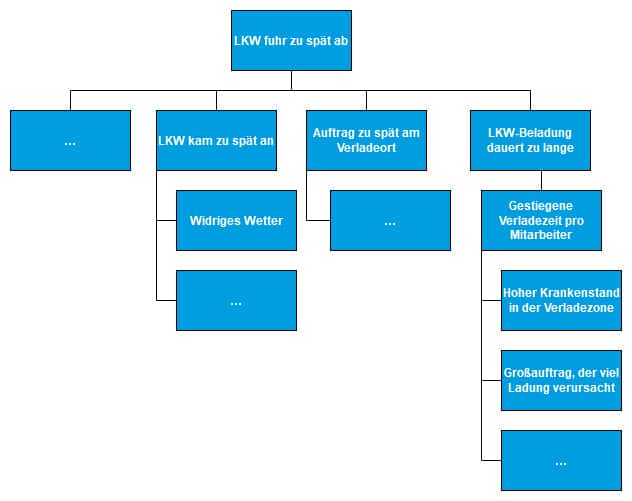
Following the diagnostic phase, predictive analytics takes over and assigns a probability of occurrence to elements of this decision tree: Thus, with each applicable parameter—such as “High Sick Leave Rate” or “Major Order”—the probability that the condition “Truck Loading Takes Too Long” will occur increases. What is applied to historical data in the diagnostic analysis is projected by predictive analysis onto a state that is still unknown or in the future. This creates the necessary response time to still be able to react to a situation. Management receives significant support in making forecasts, as individual experience with business processes becomes a less significant factor.
Complex Event Chains and Short Time Windows as Risks for Intralogistics Processes
Two example scenarios that predictive analysis is designed to detect in a timely manner are the snowball effect and the butterfly effect. In the former, errors that initially appear minor escalate into serious ones, which in the worst-case scenario can disrupt the entire process flow. In the latter, the connection between identical or similar initial conditions and significantly divergent subsequent developments in the system is inexplicable: Although the order volume and available resources are the same in a warehouse on two different days, operations run smoothly on Day A, while on Day B, disruptions occur unexpectedly.
Can the flutter of a butterfly’s wings trigger a tornado in Texas?
– Edward N. Lorenz
Applied to intralogistics, this results in a situation in distribution centers where disruptions accumulate, even though the initial conditions are not unusual and the process had previously run smoothly at another time. The connection between the effect and its cause is—as yet—unknown.
Predictive analysis can stop rolling snowballs before they turn into an avalanche, since it identifies problematic system states and their relationships. Based on the example from diagnostic analysis, a predictive path might look like this:
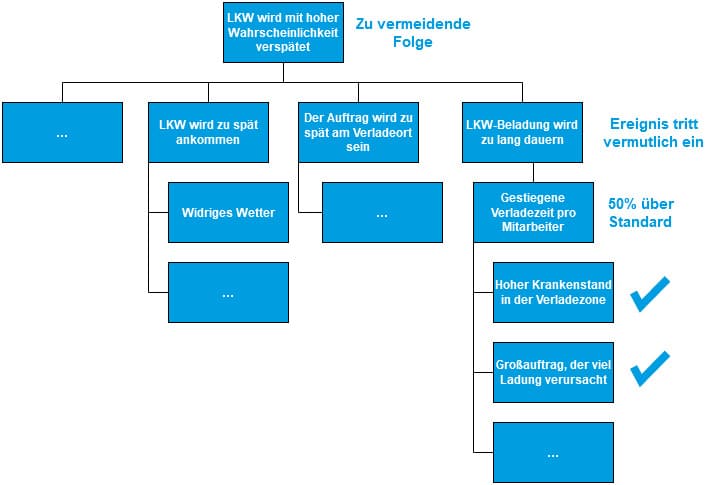
Through analytical models, such as regression analysis or decision trees, the predictive paths can be verified, falsified, and refined for greater accuracy. The goal of this ongoing process is to uncover unknown relationships and improve—or even enable—response times for identified scenarios.
In addition to a solid data foundation, the key lies in the combination of pattern recognition and evaluation, which can be supported by machine learning. In this way, event chains can be parameterized more accurately, or unknown relationships can be uncovered.
Predictive Analytics and Machine Learning
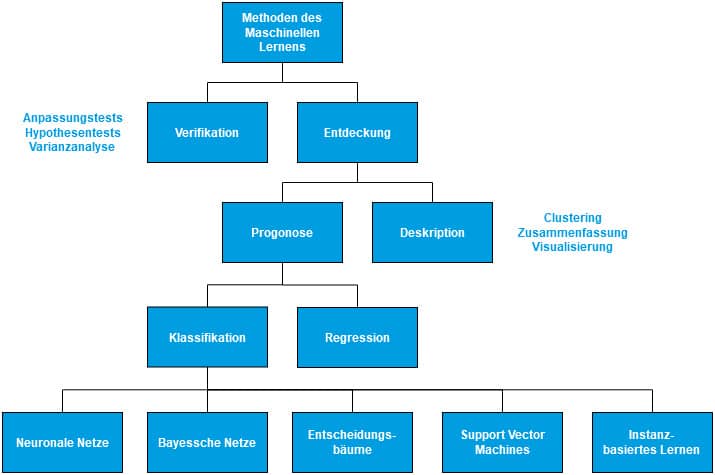
In our TUP AI Series, we have introduced the various topics in machine learning. For the two scenarios involving the improvement of predictions for known event chains, supervised learning is a promising approach that can enhance the granularity and quality of predictions: The goal can be precisely defined, and the associated conditions are known and described. This means that, in addition to data specialists, algorithms can also help further develop the models—especially when a large number of complex, interlinked events need to be analyzed.
To discover unknown patterns in the first place, unsupervised machine learning can be helpful when large, well-prepared datasets are available.
Benefits of Predictive Analytics in Intralogistics
In addition to the flow of goods, maintenance is a key focus of predictive analytics. In the article “Concepts and Methods for Predictive Maintenance in Intralogistics” by Michael Schadler, Norbert Hafner, and Christian Landschützer, it is demonstrated that this form of analysis provides a foundation for increasing efficiency through optimized maintenance cycles based on models such as Reliability-Centered Maintenance, Total Productive Maintenance, or Risk-Based Maintenance.
Many companies still rely on reactive measures or fixed maintenance intervals, which may, under certain circumstances, jeopardize ongoing operations.
The flow of goods is supported by improved forecasts, as more and finer-grained parameters are taken into account compared to traditional demand forecasts.
