

Many projects fail not because of a lack of willingness to change—but because there is too much change all at once. Minimum Viable Change is a decision-making framework that enables targeted change: with a clear focus, early feedback, and ongoing adaptability.
What is MVC?
MVC starts with a simple question: What is the specific problem we want to solve? Not: What does the ideal process of the future look like? Not: What features might we need at some point?
This distinction may sound trivial—but it fundamentally changes how a project is set up, decided upon, and carried out. The traditional approach thinks in terms of complete end states. MVC thinks in terms of minimal but effective steps.
Core principle: “A specific problem or performance goal drives the decisions. Everything else remains unchanged for now.”
Why this is particularly relevant in intralogistics
Warehouse and distribution processes are complex, highly interconnected, and often difficult to change while operations are ongoing. Major restructuring projects tie up resources for months—and the reality at go-live often differs from the original plan.
MVC addresses this very problem. Instead of rethinking a system from scratch, we ask a specific question: Which bottleneck is costing us the most today? What single change would have the greatest measurable impact? This focus reduces risk, accelerates learning, and preserves the ability to respond to new requirements—even after go-live.
Our solutions adapt to your processes — not the other way around. MVC is the methodology behind it.
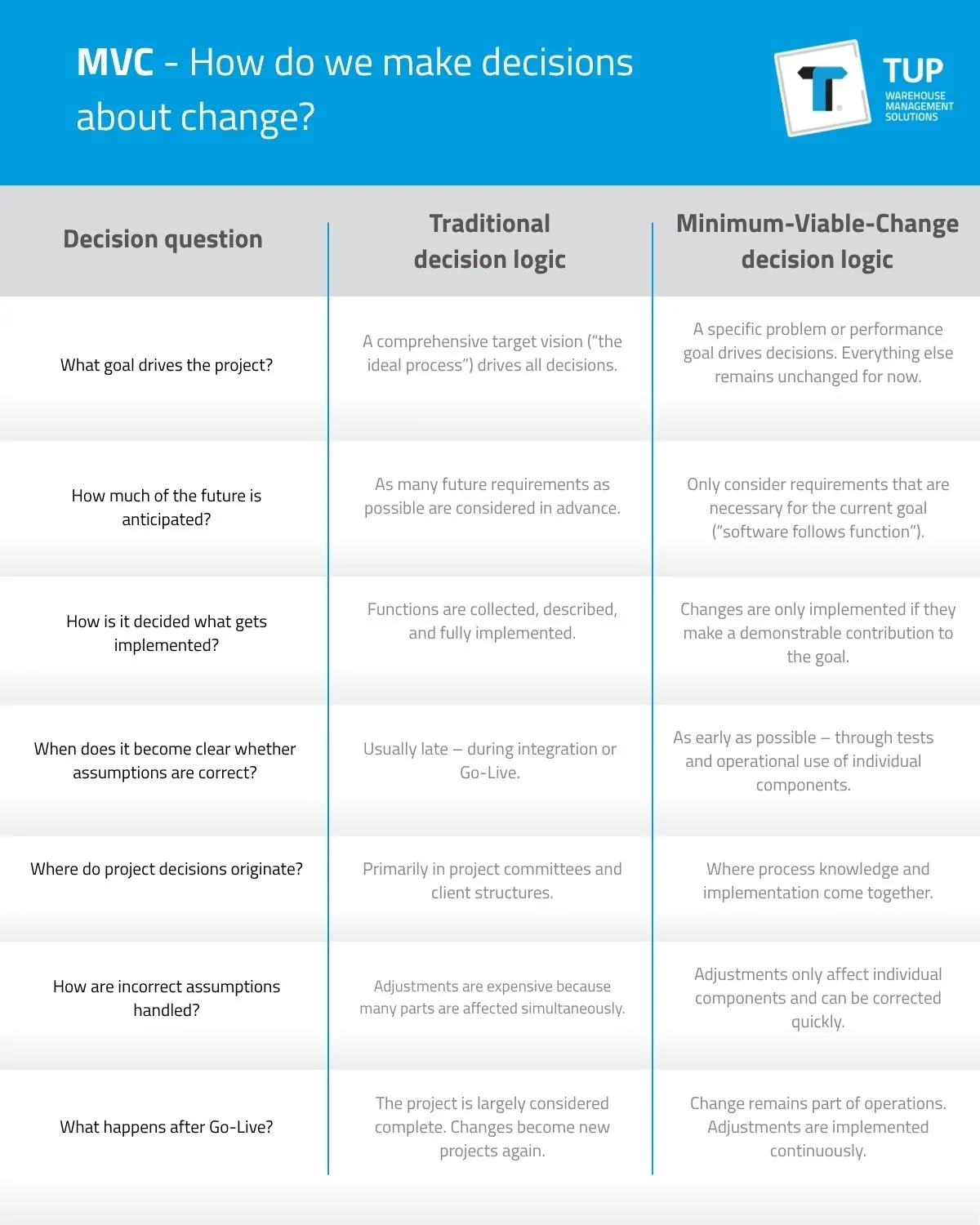
Standard approach vs. MVC
This comparison highlights how the two approaches differ in practice—from the initial definition of objectives all the way through to what happens after the go-live.
An Overview of the Four Core Principles
01 - GOAL
Problem before the destination
It is not future ideals, but present problems that drive all decisions.
02 - SCOPE
Software follows function
Implement only what is necessary to achieve the current goal. Everything else remains unchanged for the time being.
03 - LEARN
Early feedback instead of late certainty
Assumptions are tested through actual use as early as possible — not just during the full-scale launch.
04 - OPERATIONS
Change as ongoing responsibility
The go-live is not the end, but rather a starting point. Adjustments are part of day-to-day operations.
What this implies for projects
MVC is not an argument against planning — but rather for the right amount of planning at the right time. Those who define too much too early end up paying the price later for decisions based on incomplete information. Those who, on the other hand, consistently approach problems from the perspective of the current issue can take action more quickly while still remaining flexible.
This also changes where decisions are made: not primarily in committees and steering committees, but where process knowledge meets implementation expertise. This requires different structures — and a different understanding of what constitutes a successful project.
Do you have any questions?
Do you have a project inquiry or would you like individual advice?
Further reading

Minimum viable change as a compass for successful retrofits and greenfield projects
There’s always something going on with the agile approach. However, this article is not about praising the next three-word combination as a…

Change Request Management in Intralogistics
If you decide to use a warehouse management system, you usually have two options: Either you acquire a license to use the software or you are the…
