


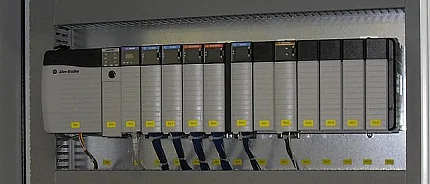
The programmable logic controller is abbreviated as PLC. According to the European standard EN 61131, it is defined as a digitally operating electronic system used in an industrial environment and equipped with a programmable memory. According to DIN EN 61131, the programmable memory is used for the internal storage of user-oriented control instructions. Special functions, such as sequence control, can be implemented to control the input and output signals of machines or processes.
The warehouse control system is responsible for controlling and positioning warehouse equipment and conveyor systems. A distinction is made between aisle-dependent and aisle-independent equipment.
Aisle-bound warehouse equipment and the conveyor systems of automated warehouses are typically controlled using the programmable logic controller. The controller is often composed of individual modules.
How a Programmable Logic Controller Works
In its simplest form, a PLC operates with the following components:
- Inputs
- Outputs
- Operating system
- Interface
The user program can be loaded via inputs, outputs, the operating system, and the interface. The program determines how the inputs and outputs are switched. The control system is linked to the facility via sensors and actuators, the controller is linked to the system. Sensors, such as light barriers, are located at central points in the system and are connected to the PLC’s inputs. They relay information about the system’s status to the PLC. Actuators are connected to the PLC’s outputs. The system can be controlled using actuators.
PLC Implementation
A PLC can be implemented in various ways. Examples include:
- PC plug-in card
- Standalone unit
- Software emulation
The combination of individual plug-in modules is widely used as a modular solution. Thanks to cost-effective components and the standardization of control tasks, the PLC concept is increasingly replacing connection-programmed control (VPS). VPS is a hard-wired control system in which the program flow is determined by fixed connections between the individual components. The PLC solution proves to be more flexible.
Further advantages over VPS include:
- Error-free
- Faster error analysis
- More cost-effective in the long run
- Less effort required for a functional change
A disadvantage compared to the VPS, for example, is that the personnel required must be more highly qualified and that the use of a programmable logic controller is too expensive for less complex systems.
For more information on material flow control, see Material Flow Control.
Image license: CC BY-SA 3.0, Author:
Elmschrat
