


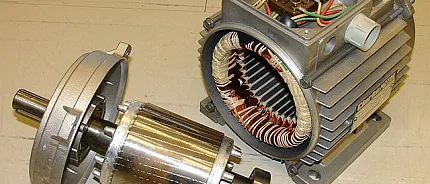
Propulsion systems generate kinetic energy for vehicles. The types of propulsion for vehicles can be divided into the categories “manual propulsion,” “gravity propulsion,” and “motorized propulsion.” Motorized propulsion systems include:
- Internal combustion engine drive
- Electric motor drive
- Hybrid drive
The electric motor converts electrical work into mechanical work. In transportation technology, electric motor drives are used in three-phase and direct current motors.
Three-phase motors
Three-phase current is created by combining three different alternating currents, hence the term “three-phase alternating current.” Three-phase motors are used when there are no strict requirements for a specific operating speed. Reversing the connections changes the direction of rotation. A three-phase motor can be either a synchronous or an asynchronous motor. In transportation technology, however, only the asynchronous motor typically plays a role. The types of electric motors classified as three-phase asynchronous motors are:
- Squirrel-cage motor
- Slip-ring motor
- Linear motor
Direct-current motors
A characteristic of direct current is that it flows constantly in one direction. Unlike three-phase current, direct current cannot be stepped up or down using a transformer, but it can store energy. Direct current can be obtained, for example, from a direct-current grid, either by a generator converting mechanical energy into electrical energy or by a rectifier converting alternating current into direct current. The different types of DC electric motors are:
- Series-wound motor
- Shunt-wound motor
DC motors are used, for example, in discontinuous conveyors .
Image license: CC BY-SA 3.0, Author: Zureks
