


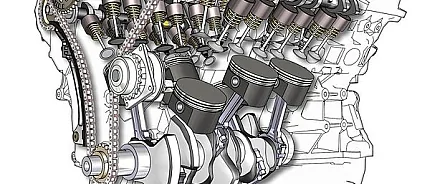
The kinetic energy for vehicles is generated by a propulsion system. In addition to motor-driven propulsion, other types of propulsion include “manual propulsion” and “gravity propulsion.” Motor-driven propulsion systems include:
- Internal combustion engine drive
- Electric motor drive
- Hybrid drive
The combustion of a fuel releases heat. This released heat is converted into energy by an internal combustion engine. Fuels used in internal combustion engine drives include:
- gasoline,
- propellant gas,
- and diesel.
In transportation technology, the diesel engine is generally the most commonly used. The rotational speeds of a diesel engine are lower than those of a gasoline engine.
A characteristic of the internal combustion engine is its high power-to-weight ratio. Compared to an electric motor, its service life is relatively short.
Internal Combustion Engine: Power Transmission
Power transmission can be mechanical, hydrodynamic, or hydrostatic. Mechanical power transmission using a clutch and manual transmission requires significant operator effort but results in good efficiency. Hydrodynamic power transmission occurs via a fluid coupling, and hydrostatic power transmission utilizes the pressure energy generated by the conversion of mechanical energy.
Advantages include high driving and lifting capacities, the ability to climb steep inclines, and rapid operational readiness. Furthermore, the minimal challenges associated with energy supply make the use of an internal combustion engine a compelling option. It takes less time to refuel a vehicle than it does to charge a battery.
Disadvantages include, among other things, high noise levels, air pollution, the need for exhaust gas purification, and the fact that vehicles powered by internal combustion engines can only be used to a limited extent in enclosed spaces.
For more information on motorized drives, see Electric Motor.
Image license: CC0 1.0, Author: Swaroopvarma
