


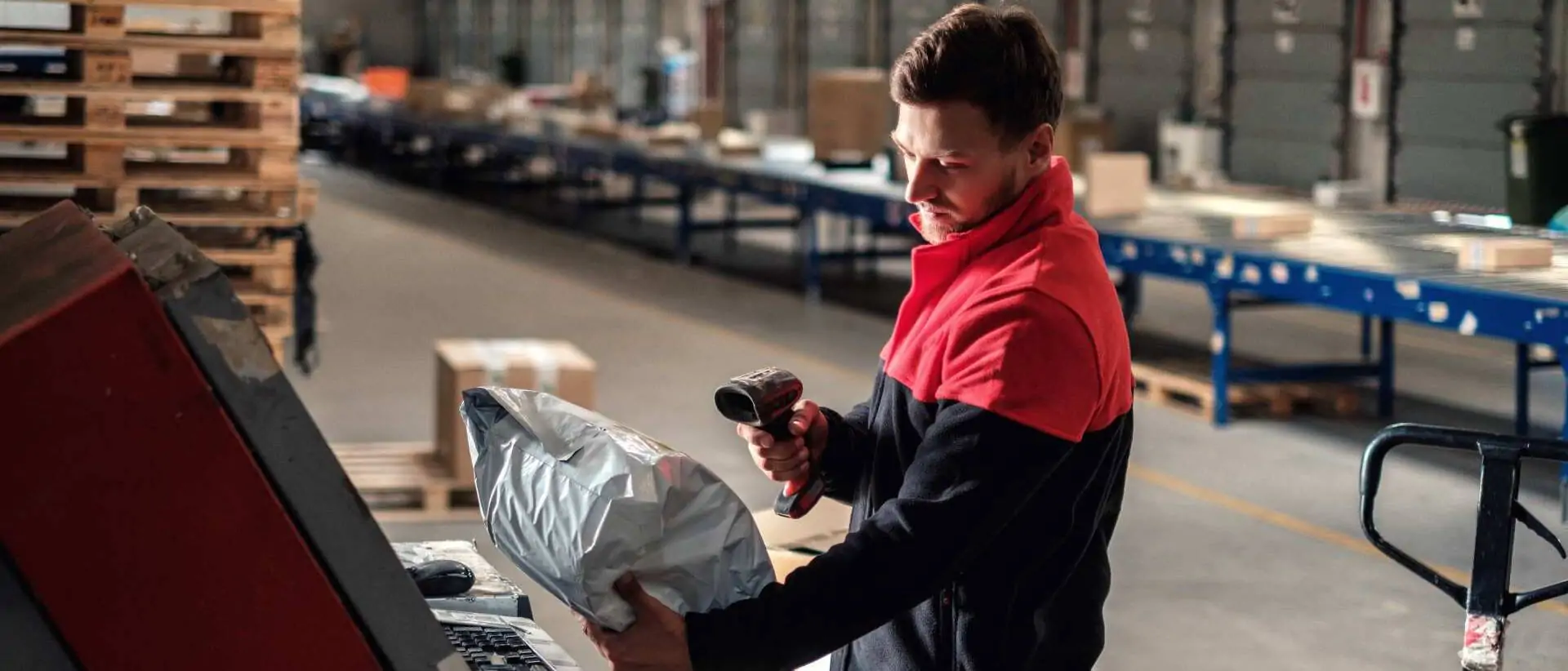
Consolidation refers to the process of combining individual parts into a whole. In logistics, this means that individual transport goods are combined into a more compact, larger unit. In intralogistics in particular, the aim is to make the handling of goods more economical and to achieve savings in transport costs.
Meaning of consolidation in the warehouse
In the warehouse, the consolidation process is closely linked to order picking and the goods issue process. Goods to be removed from storage are grouped together in a logical manner for shipping. Especially when the order picking process is divided across several storage areas, goods issue has a consolidation function, as all parts of a shipment must be brought together after order picking.
To solve the consolidation task, the simplest case is to collect the packages in staging areas in goods issue. For example, goods can be consolidated according to their postal code areas to the corresponding destination relations.
Types of consolidation
There are two types of consolidation in logistics:
Temporal consolidation
Temporal consolidation is also known as inventory consolidation. With temporal consolidation, the delivery of goods may be delayed. Goods that are to be shipped from the same location are first collected. Only when enough goods have been accumulated to reach a certain nominal value in terms of transport capacity are the goods shipped.
This form of consolidation has advantages for both the sender and the recipient. The advantage for the sender is that they can utilize their full capacity and thus save on transport costs. The advantage for the recipient is that shipments arrive in bulk.
Spatial consolidation
This type of consolidation involves combining traffic flows. A vehicle makes several stops on a tour to pick up goods. Similarly, the goods are delivered to different locations. The tour is planned so that all goods can be picked up and delivered as quickly as possible within one tour. However, driving to several pick-up and drop-off stations results in a series of stops, which extends the travel time. One variation is the so-called milk run.
The advantage of spatial consolidation here is also the potential savings in transport costs due to the reduced number of trips.
The counterpart to consolidation is deconsolidation.
Various strategies can be used to carry out existing transport orders. For more information on station strategies, route strategies, empty run strategies, and traffic strategies, see Transport Strategies.
Additional information on consolidation can be found here.
Image source: © il-fede – Fotolia.com
