


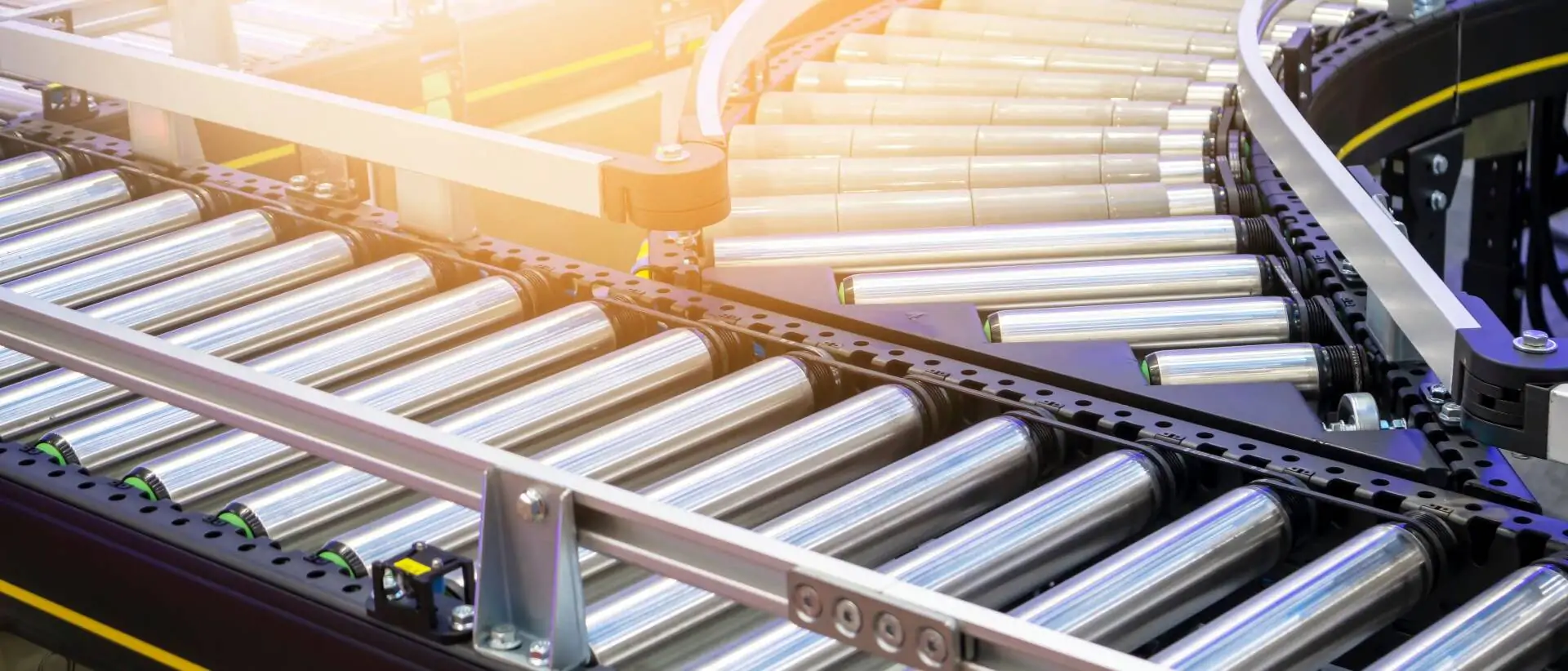
Material handling is a central subfield of intralogistics and encompasses all technical equipment, systems, and processes used for the transport, handling, distribution, storage, and consolidation of goods within a facility or between operational areas. It forms the backbone of modern material flow processes and contributes significantly to the efficiency, cost-effectiveness, and automation of industrial and logistical operations. While transport logistics deals with the movement of goods between different locations, intralogistics focuses on all material and information flows within a company, a logistics center, or a production facility. Conveyor technology is responsible for moving goods safely, cost-effectively, and as automatically as possible from one process step to the next.
With increasing digitalization, rising demands for delivery speed, and the growth of e-commerce, conveyor technology is continuously gaining in importance. Today, modern conveyor systems are closely integrated with warehouse management systems, production control systems, and automated identification systems. This results in highly integrated material flow systems that enable largely autonomous control of logistics processes.
Definition of Material Handling Technology
Conveyor technology refers to the totality of all technical means and equipment used to convey, move, lift, lower, distribute, collect, and store piece goods, bulk goods, or loading units within a defined spatial area. The goal of conveyor technology is to organize material flows efficiently and minimize the effort required for transport between different workstations or storage areas.
Material handling is a component of material flow engineering and overlaps with the fields of warehouse technology, material handling technology, and automation technology. It ensures that goods are made available at the right time, in the right quantity, and at the right location. In addition to the actual transport, it often performs additional functions such as buffering, sorting, consolidating, or separating goods.
The design of a conveyor system is based on various factors, including:
- Type and characteristics of the material being conveyed
- Conveying capacity
- Transport distance
- Elevation differences
- Degree of automation
- Energy consumption
- Safety requirements
- Cost-effectiveness
- Maintenance requirements
Depending on the application, different conveying methods and control concepts are used.
Importance in Intralogistics
Conveyor technology connects all of a company’s logistical functions.
It forms the physical infrastructure through which material flows move between goods receipt, the warehouse, production, order picking, packaging, and goods shipment.
In modern logistics centers, several hundred thousand transport operations are carried out daily. Without automated conveyor systems, these material movements would only be possible with a significant workforce. The use of intelligent conveyor systems can reduce transport times, minimize errors, and lower process costs.
Conveyor technology fulfills several tasks simultaneously:
- continuous material transport
- supplying production lines
- connecting individual warehouse areas
- order-picking support
- Sorting of shipments
- Provision of goods
- Return of empty load carriers
- Buffering of material flows
It thus forms the basis for a continuous material flow without unnecessary interruptions.
Materials to Be Conveyed
The design of a conveyor system depends largely on the characteristics of the material to be conveyed. A basic distinction is made between unit load goods and bulk goods.
Discrete Goods
Discrete goods have a defined shape and can be transported individually. Examples include:
- Cardboard boxes
- Containers
- Pallets
- Packages
- Machine components
- Barrels
- Crates
- Workpieces
Unit load goods dominate conveyor technology in distribution centers, production facilities, and shipping warehouses.
Bulk goods
Bulk goods consist of a large number of small individual components. These include, for example:
- Sand
- Gravel
- Grain
- Coal
- Granules
- Powder
- Cement
- Ores
Special conveyor systems are used for bulk materials to enable a continuous flow of material.
Main Functions and Classification of Conveyor Technology
Conveyor technology performs numerous functions within logistics systems.
Transport
The most important task is the horizontal, vertical, or combined transport of goods between different process stations.
Lifting and Lowering
Many conveyors overcome differences in elevation, for example between different storage levels or production areas.
Distribution
Material flows can be distributed to various destination stations. This is often done automatically via diverters or sorting systems.
Merging
Multiple material flows are merged into a single main flow within a conveyor system.
Buffering
Conveyor systems often serve as temporary storage to compensate for differences in processing speeds.
Sorting
Packages or containers are automatically distributed according to their destination address or order number.
Positioning
In production, workpieces often need to be positioned precisely at processing stations.
Classification of Conveyor Technology
Conveyor technology is classified according to various criteria:
Continuous Conveyors
Continuous conveyors move materials continuously or at short intervals along a fixed conveying path.
Typical examples include:
- Roller conveyors
- Belt conveyors
- Chain conveyors
- Screw conveyors
- Bucket elevators
- Conveyor belts
They are characterized by high conveying capacities and a uniform flow of material.
Batch Conveyors
Batch conveyors transport individual loads in discrete cycles.
These include, among others:
- Forklifts
- Cranes
- Elevators
- Automated storage and retrieval systems
- Automated guided vehicles
- Pallet jacks
They are particularly well-suited for flexible transport tasks.
Important Conveying Equipment
Roller conveyors
Roller conveyors are among the most commonly used conveying systems in general cargo transport. They consist of rollers arranged in a row, over which boxes, containers, or pallets are moved.
The following types are distinguished:
- Gravity roller conveyors
- Powered roller conveyors
- Accumulation roller conveyors
- Curved roller conveyors
Belt conveyors
Belt conveyors transport goods via a circulating conveyor belt. This type is particularly suitable for light to medium-weight goods.
Advantages include:
- quiet operation
- high transport speed
- gentle material handling
- low maintenance requirements
Chain conveyors
Chain conveyors are primarily used for heavy loads. Typical goods transported include pallets, mesh boxes, or machine components.
Overhead conveyors
Overhead conveyors transport goods above the work area, thereby freeing up floor space. They are frequently used in the automotive industry or in paint shops.
Lifting Tables
Lifting tables connect different conveying heights and also facilitate ergonomic workstations.
Elevators
Vertical conveyors or freight elevators bridge significant height differences within logistics facilities.
Automated Guided Vehicles (AGVs)
A major focus of development in modern material handling technology is automated guided vehicles (AGVs). These consist of autonomous vehicles that transport materials between different stations.
Various methods are used for navigation:
- Laser navigation
- Magnetic strips
- QR codes
- Camera systems
- Natural navigation using sensors
- SLAM (Simultaneous Localization and Mapping)
Autonomous guided vehicles enable flexible material flows without permanently installed conveyor lines and can be adapted relatively easily to changing production conditions.
Autonomous Mobile Robots
Autonomous mobile robots (AMRs) represent a further development of traditional automated guided vehicles (AGVs). Unlike traditional AGVs, they navigate their environment independently and dynamically calculate their paths.
This enables them to:
- navigate around obstacles
- select alternative routes
- independently prioritize tasks
- collaborate with people
AMRs are becoming increasingly important, particularly in e-commerce and in flexible production systems.
Automation of Material Handling
Today, material handling is one of the most highly automated areas of intralogistics. Modern systems are coordinated by programmable logic controllers (PLCs), material flow computers, and warehouse management systems.
Typical components include:
- Sensors
- Photoelectric sensors
- Barcode scanners
- RFID systems
- Cameras
- Weighing systems
- Dimensioning systems
- Identification systems
These continuously provide information on the position, speed, and condition of the goods being conveyed.
Based on the order data, the control software determines:
- Destination station
- Conveyor route
- Prioritization
- Buffering strategies
- Sorting
- Utilization of individual conveyor lines
This results in highly automated material flow systems with minimal personnel requirements.
Interfaces to Other Areas
Conveyor technology works closely with other areas of intralogistics.
Warehouse Technology
Automated high-bay warehouses and small-parts warehouses are directly connected to conveyor systems.
Order Picking
Conveyor technology transports items to order-picking workstations or handles the onward transport of completed orders.
Packaging
After packaging, shipments are automatically routed to sorting facilities or shipping areas.
Production
Production lines are continuously supplied with materials, and finished products are removed.
Shipping Logistics
In the outbound area, conveyor systems distribute goods to shipping lanes or loading docks.
Planning Conveyor Systems
The planning of a conveyor system takes place in several steps.
First, the material flow is analyzed. Subsequently, conveyor capacity, peak loads, and future expansions are taken into account.
Important planning parameters are:
- Conveyor capacity
- Conveyor speed
- Throughput
- Reliability
- Redundancy
- Energy consumption
- Space requirements
- Ease of maintenance
- Capital costs
- Life-cycle costs
The goal is to achieve an overall system that is as cost-effective as possible while ensuring high availability.
Advantages and Challenges of Modern Conveyor Technology
The use of automated conveying technology offers numerous advantages.
These include, in particular:
- lower transportation costs
- higher productivity
- shorter turnaround times
- fewer errors
- greater process reliability
- better capacity utilization
- reduced staffing requirements
- greater transparency
- improved ergonomics
- greater delivery reliability
- consistent material flow
- better scalability
Conveyor systems often pay for themselves within a few years, especially when handling large volumes of material.
Challenges
Despite their advantages, conveyor systems also present various challenges.
These include:
- high investment costs
- complex planning
- Maintenance costs
- Integration of existing systems
- Increasing IT security requirements
- Growing variety of product variants
- Fluctuating material flows
- high availability requirements
In addition, conveyor systems must be regularly modernized to keep pace with new production and logistics processes.
The Future of Conveyor Technology
The future development of conveyor technology will be significantly shaped by digitalization, automation, and artificial intelligence. Intelligent conveyor systems continuously analyze their operating status and can identify maintenance needs at an early stage. With the help of sensor technology and data analysis, unplanned downtime can be reduced and maintenance measures planned as needed.
Another trend is the increased networking of all intralogistics components in the form of cyber-physical systems. Conveyor systems communicate in real time with warehouse management systems, robots, production machines, and autonomous vehicles. This allows material flows to be flexibly adapted to changing order conditions.
Sustainability aspects are also becoming increasingly important. Energy-efficient drives, regenerative braking systems, intelligent load control, and resource-conserving operating strategies help lower energy consumption and reduce CO₂ emissions from logistics processes.
At the same time, modular conveyor technology is becoming increasingly important. Standardized components make it easier to expand or redesign existing systems, enabling companies to respond more quickly to changes in the market.
Summary
Conveyor technology is an indispensable component of intralogistics and forms the technical foundation for the internal flow of materials. It encompasses all equipment and processes for transporting, lifting, lowering, distributing, buffering, and sorting goods within logistics systems. Depending on the characteristics of the goods being conveyed and operational requirements, various conveying methods—such as roller conveyors, belt conveyors, chain conveyors, lifting systems, or automated guided vehicles—are used.
Due to advancing automation, digitization, and networking, conveyor technology is increasingly evolving into an intelligent integrated system that efficiently links material and information flows. Modern conveyor systems make a decisive contribution to increasing productivity, process reliability, and cost-effectiveness, and are thus an essential prerequisite for high-performance production and logistics systems. Given the growing demands for flexibility, sustainability, and delivery speed, their importance in intralogistics will continue to increase in the future.
